Students who live and learn in intentional residential communities consistently outperform their peers: higher GPAs, lower dropout rates, stronger academic engagement. This holds across institutions and study designs (Inkelas et al., 2007). It is not a coincidence of culture—it is a structural effect.
Spanierman et al., writing in the Journal of Student Affairs Research and Practice (2013), show that the benefits extend well beyond grades. Living-learning communities deepen intellectual exchange between students and build a sense of belonging—what Abraham Maslow identified as a fundamental human need and a foundation of psychological health. (Maslow, 1954). The foundation for these claims is supported by research specifically examining the academic performance and retention of first-year students within these living-learning environments (Purdie, 2007). Subsequent longitudinal data confirms that these benefits—including a strengthened sense of belonging and intellectual engagement—persist even after controlling for prior academic ability and background variables (Purdie & Rosser, 2011).
The House of Sciences translates this model into a contemporary context. It combines residential living with the kind of working culture that has proven foundational to scientific and entrepreneurial success—in the orbit of Stanford in Palo Alto, at ETH in Zurich, in the collegiate structures of Oxford. The organizing principles are not administrative but relational: personal responsibility, flat hierarchies, and deliberate connection.
Open Mindset and Economic Literacy
The House of Sciences is conceived as an intellectual resonance chamber for people with serious ambition and a global orientation. Research suggests that high-performance learning communities reach their full potential when members share similar intellectual standards and challenge each other to raise them (Inkelas et al., 2007).
The central intellectual framework is an understanding of economic transformation. Schumpeter described the mechanism as a process of industrial mutation that incessantly revolutionizes the economic structure from within—destroying the old, creating the new. This principle of creative destruction—refined empirically by Aghion and Howitt (1992) as the basis of endogenous growth models—provides the conceptual backdrop against which residents develop their entrepreneurial and scientific work. The house offers the physical and digital infrastructure that the next generation of decision-makers in business and science actually needs.
Strategic Location and Transnational Connectivity
Situated at the geographic center of Germany, Meiningen functions as a genuine logistical hub—not a compromise location, but an optimized one.
Global home base: For successful German entrepreneurs living abroad, the house provides a permanent, drop-in-ready base in the heart of Germany—with a registered address and the infrastructure needed for strategic visits.
International launchpad: For young talent, the collegium serves as a staging ground for building ventures in markets like the US or China.
Rail and highway connections put Frankfurt, Munich, Stuttgart, and Berlin within easy reach. And train travel is not dead time: research from University College London with the Rail Delivery Group shows that rail journeys offer measurable psychological benefits for wellbeing and cognitive function—particularly when used for deliberate preparation and reflection (Devlin & Richardson, 2021). The commute, in other words, is part of the work.
Scientifically Validated: The Optimal “Q-City”
The choice of Meiningen is not sentimental. It is data-driven. Researchers at the Technical University of Kaiserslautern ran a multi-criteria analysis to identify the mathematically optimal location for a city in Germany.
The thought experiment was clean: strip away existing infrastructure, repopulate the country from scratch, and apply rigorous criteria from geoscience and quality-of-life research. The result:
- Centrality: Optimal accessibility across the entire country.
- Topography & resources: Ideal conditions for water supply, soil quality, and geographic configuration.
- Climate & livability: Top statistical scores for weather and recreational access.
The analysis was published under the name Q-City. It was conducted by the Department of Computer-Aided Planning and Design at the University of Kaiserslautern, commissioned by the WDR science program Quarks & Co (2000). Meiningen sits at that optimal point.
This data-driven placement aligns with broader urban economic theories suggesting that innovation is intrinsically linked to the specific growth patterns and structural advantages of cities (Acs, 2002). By situating the research collegium at this geographic “optimal point,” the project leverages its location to serve as an international launchpad and an intellectual resonance chamber for a new generation of decision-makers.
Infrastructure and Architectural Concept
The physical setup of the house reflects the profile of its residents. Dedicated workspaces, an in-house library, gigabit connectivity, and a professionally equipped shared kitchen create the material conditions for focused, productive work—not as amenities, but as infrastructure.
The built environment has a direct effect on cognitive performance. A controlled study from the Harvard T.H. Chan School of Public Health found that knowledge workers in optimized indoor air conditions scored up to 61% higher on cognitive tests than those in conventional office environments (Allen et al., 2016). A systematic review by Wang et al. (2021)—drawing on 66 studies—confirms that nearly every environmental factor matters: air quality, thermal comfort, noise, light intensity and color temperature, acoustics. The variables are not interchangeable: attention is acutely sensitive to light and air quality; memory is degraded by noise and thermal stress; higher cognitive functions—problem-solving, planning—are most vulnerable to a combination of poor air and suboptimal temperature. The house is designed with all of this in mind.
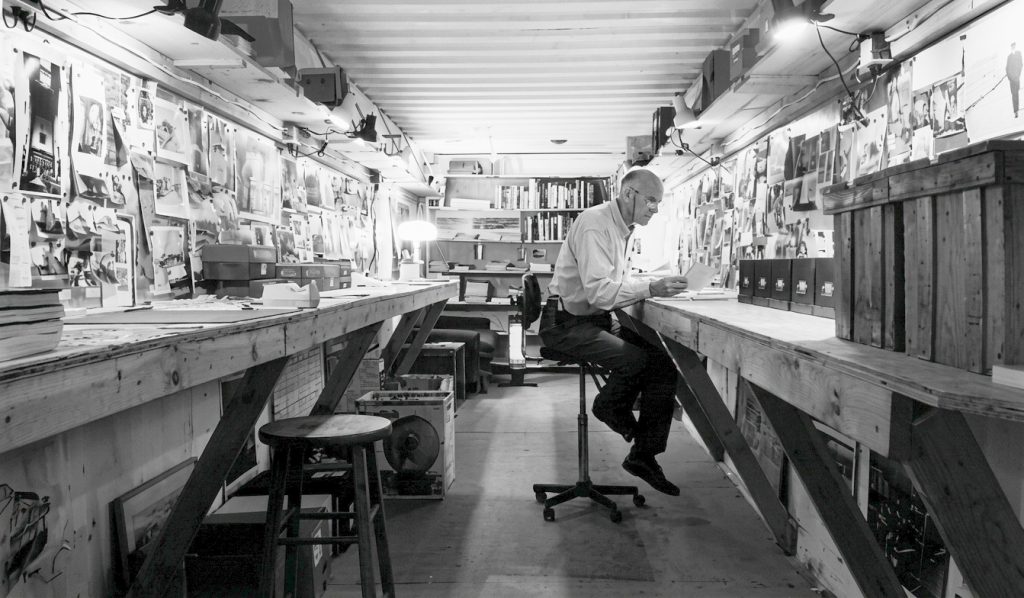
February 1993 | The workspace as a tool of Creative Destruction. Much like Stewart Brand’s iconic shipping container library (pictured), the House of Sciences provides a high-density, low-overhead environment where digital work and physical research converge. It is an architecture of ‘loose fits’—spaces that can be updated and reclaimed without losing their coherence.
Academic Networks
The surrounding region offers a remarkable density of research institutions and universities—all the more striking given that the area is primarily known to outsiders as a nature retreat and holiday destination:
- Schmalkalden (~30 min.): Focus on computer science, robotics, and commercial law. The campus—designed by Kammerer/Belz und Partner (Stuttgart, 1995–2000)—has its own train station directly adjacent to the lecture halls.
- Bad Neustadt (~60 min.): A leading center for electromobility and digital health.
- Ilmenau & Jena (~90 min.): International standing in optics, photonics, medical technology, and applied physics—with access to specialized research facilities and global players including ZEISS and Jenoptik.
- Coburg & Schweinfurt (regional): Specializations in automotive engineering, hydrogen technology, and international management.
The cost-of-living advantage is real and consequential. Moderate expenses at high residential quality means more resources available for research travel, independent projects, and the kind of flexibility that creative work actually requires.
Quality of Life
The house sits on the Werra river—one of the cleanest waterways in Germany—with direct access to running and cycling routes that many residents describe as the most productive thinking time of their day. Sports and swimming facilities are walkable. When you step away from your desk, you are outside in minutes.
The house cultivates community through shared resources—bicycles, sports equipment, library. On the second Saturday of each month, the Haus der Wissenschaften hosts a salon: members and guests present work in progress, current projects, open questions. The format sits deliberately between academic colloquium and open conversation—structured enough to be useful, loose enough to be honest.
Vision and Authorship
The built environment has a direct effect on cognitive performance. A controlled study from the Harvard T.H. Chan School of Public Health found that knowledge workers in optimized indoor air conditions scored up to 61% higher on cognitive tests than those in conventional office environments (Allen et al., 2016). A systematic review by Wang et al. (2021)—drawing on 66 studies and a keyword analysis of 8,133 further publications—confirms that nearly every environmental factor matters: air quality, thermal comfort, noise, light intensity and color temperature, acoustics, and non-visual spatial factors. The variables are not interchangeable. Depending on the task at hand—creative writing versus data verification, for instance—different environmental factors need to be prioritized. Attention is acutely sensitive to light and air quality. Memory is degraded by noise and thermal stress. Higher cognitive functions—problem-solving, planning—are most vulnerable to a combination of poor air and suboptimal temperature. The house is designed with all of this in mind.
Ansgar’s approach to architecture brings together scientific precision and sensory experience. Extended stays in timber-framed houses in Tokyo and San Francisco, combined with the construction of his own study—with a raised floor system and fully revisable technical infrastructure—have shaped the design of the Haus der Wissenschaften in Meiningen in direct and traceable ways.
“Spaces that can be updated without losing their coherence.”
— Ansgar Halbfas, 2018
The house is also a showcase of his work as an architect. Moving in means experiencing firsthand how considered spatial planning—material selection, acoustics, revisable technology integration—shapes everyday concentration and quality of life. For clients looking to develop a project at the same level of ambition, the house is the most direct window into how Ansgar works.
If you are open to technical innovation and still know that a room is more than its specifications—then Ansgar thinks in your register. Complex projects only succeed between people who share the same standards and the same respect for the work.
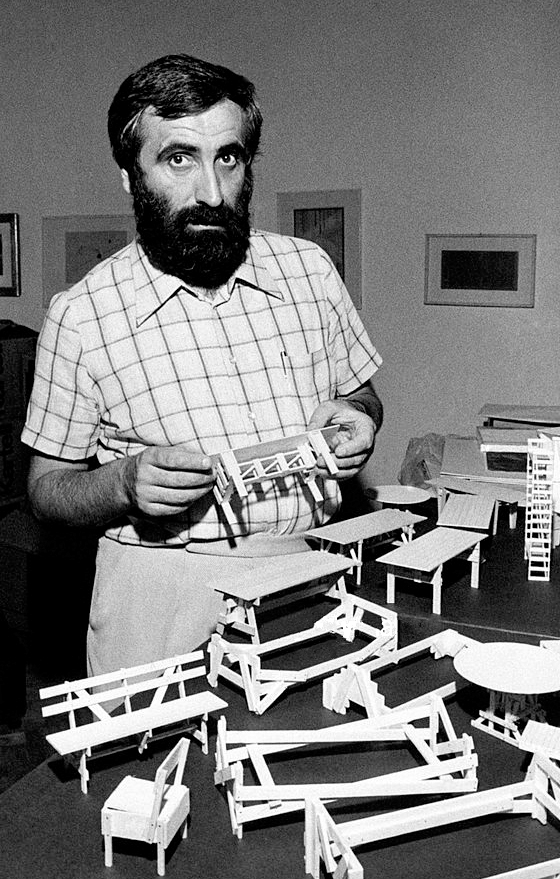
The Autoprogettazione? manual was created by Italian designer Enzo Mari in 1974 as a design guide to a collection of furniture that could be assembled from the most basic materials, using just a hammer and nails.
A seminal exercise in democratic design that prioritizes structural logic over aesthetic artifice. Scientifically, the style is rooted in elementary geometry and standardization, utilizing common industrial lumber and basic joinery to make furniture construction accessible to the layperson.
By stripping an object down to its essential load-bearing components, Mari invites the user to understand the physical forces at play—such as tension and compression—transforming the consumer into a conscious maker. It is a functionalist philosophy that argues quality design isn’t found in a luxury price tag, but in the rational relationship between material, assembly, and purpose.
References
Aghion, Philippe; Howitt, Peter (1992). A model of growth through creative destruction. Econometrica. 60 (2): 323–351.
Allen, J. G. et al. (2016). Associations of cognitive function scores with carbon dioxide, ventilation, and volatile organic compound exposures in office workers: A controlled exposure study of green and conventional office environments. Environmental Health Perspectives. 124 (6): 805–812.
Mari, E. (1974). Autoprogettazione? Corraini Edizioni.
Maslow, A. H. (1954). Motivation and personality. Harper & Row.
Inkelas, K. K. et al. (2007). Living-learning programs and first-generation college students’ academic and social transition to college. Research in Higher Education. 48 (4): 403–434.
Purdie, John R. (2007). Examining the academic performance and retention of first-year students in living-learning communities, freshmen interest groups and first-year experience courses. University of Missouri-Columbia.
Purdie, J. R; Rosser, V. J (2011). Examining the academic performance and retention of first-year students in living-learning communities and first-year experience courses. College Student Affairs Journal. 29 (2), 95–112, 179.
Devlin, J., & Richardson, D. (2021). Train is good for the brain: Neuroscientific research on commuting by rail and cognitive performance. Rail Delivery Group.
Schumpeter, Joseph A. (1942). Capitalism, Socialism and Democracy. Harper & Brothers.
Spanierman, L. B. et al. (2013). Living learning communities and students’ sense of community and belonging. Journal of Student Affairs Research and Practice, 50 (3): 308–325.
Universität Kaiserslautern, Lehr- und Forschungsgebiet Computergestützte Planungs- und Entwurfsmethoden (2000). Q-City: Multikriterienanalyse zum optimalen Stadtstandort in Deutschland. Durchgeführt im Auftrag von WDR Quarks & Co. Meininger Tageblatt, 4. Mai 2000.
Wang, C. et al. (2021). How indoor environmental quality affects occupants’ cognitive functions: A systematic review. Building and Environment, 193.