The Civilizational Cost of Not Building
The affordability crisis in residential construction is frequently discussed in the language of economics—supply curves, interest rates, land values. These framings are accurate as far as they go, but they obscure a more fundamental question: what happens to a society that systematically fails to provide shelter at a cost its members can meet?
One way to frame the answer: housing costs have become a mechanism of what Jürgen Habermas called the “refeudalization of the public sphere”—a process by which private economic interests, operating through the accumulated weight of institutional systems, present themselves as if they were general social goods (Habermas, 1962). The large institutional investors who dominate the student and researcher housing market in German cities do not merely offer a product. They manufacture the appearance of community—through branding, amenity packages, and curated common areas—while systematically foreclosing the spatial conditions under which genuine community forms. This is not a conspiracy. It is what Habermas would call a system operating according to its own logic, indifferent to the lifeworld it displaces. The strategies documented on this page are, in this sense, not merely technical improvements to a supply chain. They are interventions in that system.
The historical record on this point is not ambiguous. Research by Raj Chetty and colleagues at Harvard’s Opportunity Insights program has demonstrated that residential stability in childhood is among the strongest predictors of long-term economic mobility—that the neighborhood a person grows up in shapes their educational outcomes, their employment, and their earning trajectory in ways that persist across decades (Chetty et al., 2016). When housing costs push families repeatedly across city boundaries in search of affordable rent, the social fabric that produces stable communities—schools, local institutions, professional networks, inter-generational knowledge transfer—is disrupted at its foundation. The costs are not borne by the institutions that created the conditions. They are borne by the children.
The strategies documented on this page are not merely technical improvements to a supply chain. They are, in the aggregate, interventions in a system that is currently producing that outcome at scale. They deserve to be understood—and pursued—with that weight attached.
Reclaimed Materials, Circular Procurement, and Adaptive Reuse
The Undervalued Resource of the Existing Building Stock
European building demolition generates approximately 900 million tonnes of construction and demolition waste annually, the majority of which is downcycled into low-value applications such as road sub-base or landfill. This represents a profound market failure (Ellen MacArthur Foundation, 2019). Structural timber, masonry units, roof tiles, sanitary ware, internal joinery, staircases, structural steel sections, and facade elements removed from buildings are in many cases fully serviceable and could be redeployed at a fraction of the cost of equivalent new materials—if procurement systems were organized to capture them.
Selective demolition—also termed deconstruction—is the practice of carefully dismantling buildings in a sequence that preserves the reuse value of their components, rather than simply demolishing and crushing the fabric (Durmisevic,2006). It is more labor-intensive than conventional demolition (typically by a factor of two to three), but recoversmaterials whose value, in a well-organized market, substantially exceeds the additional labor cost. In countries where this market is emerging—notably the Netherlands, Belgium, and to a lesser extent Germany—reclaimed structural timber can be sourced at 40–70% of the cost of equivalent new material; reclaimed clay roof tiles at 20–50%; and reclaimed steel sections at 30–60% savings relative to new.
Circular Procurement and Digital Material Passports
The principal barrier to scaled reclaimed material markets is information: buyers cannot reliably know what materials are available, in what quantities, in what condition, and with what performance specifications. Digital material passports—structured data records associated with building components that record their material composition, structural properties, and maintenance history—are emerging as the key enabling technology for circular construction procurement (Paduart et al., 2013). When components are tagged at installation (using RFID, QR codes, or other identification systems) and their passport data is maintained through building management systems, they become identifiable and specifiable assets in secondary markets.
As passport data accumulates, AI-assisted matching platforms—analogous to existing timber or steel commodity exchanges—could route reclaimed materials efficiently to projects where they are most suitable, transforming what is currently a fragmented, informal secondary market into a functional, scalable supply chain for residential construction (Ratti & Claudel, 2016).
Adaptive Reuse of Non-Residential Buildings
The conversion of redundant non-residential buildings—commercial offices, retail stores, industrial warehouses, car parks—into residential accommodation offers a route to housing production that substantially avoids the cost of new structural construction (Schmidt & Austin, 2016). The existing structure, envelope, and frequently the building services infrastructure of such buildings can be retained and repurposed, with new residential fit-out inserted within the existing shell. In well-documented conversion projects, the structural and envelope costs that typically account for 30–40% of new residential construction budgets are largely eliminated, replaced by the (usually lower) cost of modification and adaptation.
Several documented conversion projects in London, Amsterdam, and Paris have demonstrated that office-to-residential conversion can deliver completed units at 15–35% below the cost of equivalent new residential construction on the same site.
Design for Assembly: The Human Layer That Software Cannot Replace
Every strategy discussed on this page assumes, at some level, a professional intermediary: a contractor, a procurement officer, a certified installer. That assumption is worth questioning—not because professionals are unnecessary, but because their institutional gatekeeping has become one of the primary mechanisms by which housing costs are kept beyond the reach of the people who need housing most.
There is a different model. It is older than the Kammersystem, older than the building trades as currently constituted, and it is re-emerging in a new form. Its premise is simple: if a building is designed from the outset so that its assembly requires skill but not certification—so that its components can be understood, transported, and joined by people with training but without credentials—then the labor cost of construction collapses, and the social equation changes entirely.
This is not a theoretical proposition. IKEA’s flat-pack logic, applied to furniture, has demonstrated for decades that complex three-dimensional assemblies can be executed by people with no professional training if the design tolerates no ambiguity in the sequence. The same principle, applied at the scale of a dwelling, is what researchers in the field of open-source architecture and design for disassembly have been developing with increasing rigor (Crowther, 2005; Durmisevic, 2006). The structural logic is not different. The regulatory logic, however, is—and it is precisely that regulatory logic, not any technical limitation, that has kept assembly-first housing from scaling.
What we are proposing here is not a workaround. It is a design standard: buildings whose components are engineered to be joined, adjusted, and if necessary disassembled by people working with instructions rather than credentials. Connections that are bolted, not welded. Panels that are lifted by two people, not a crane. Floor systems that are dry-jointed, not cast in place. Roof assemblies that follow a sequence a literate person can follow from a diagram. None of this precludes structural integrity—it demands a higher order of structural thinking at the design stage, precisely so that the execution stage can be democratized.
The Social Argument
Automation and AI are restructuring labor markets in ways that economic forecasts have consistently underestimated in pace and scope. The sectors most exposed to displacement are not exclusively low-skill manufacturing—they include significant portions of administrative, logistical, and routine analytical work that have historically provided stable entry-level employment for young people without university credentials. What is being displaced, in other words, is not just income. It is the structured pathway through which a generation acquires competence, dignity, and a stake in the material world.
Building one’s own shelter has, across almost every human culture and most of human history, been among the primary mechanisms by which a person acquires that stake. The progressive removal of that possibility—through regulatory complexity, credentialing requirements, and the financialization of land and construction—is not a side effect of modernization. It is a political choice, made incrementally, whose costs are borne almost entirely by those least equipped to absorb them.
Karp and Zamiska, in The Technological Republic, make a related argument about national service: that a society should only ask people to bear shared risks when they are given a shared stake in the outcome (Karp & Zamiska, 2025). The young person priced out of housing, excluded from the construction trades by credentialing barriers, and now facing automation-driven displacement from whatever alternative employment remained—that person has been asked to bear considerable risk with no corresponding stake. Assembly-first housing design is one concrete response to that condition. It is not charity. It is architecture as redistribution of agency.
What This Looks Like in Practice
The House of Sciences is developing, in parallel with its materials research program, a set of design protocols for assembly-first residential structures. The specific characteristics we are targeting:
- Component weight ceiling of 80 kg — the upper limit for two-person manual handling without mechanical assistance, based on ergonomic research standards (ISO 11228-2).
- Connection vocabulary of no more than six junction types — sufficient for structural diversity, few enough to be learned in a day.
- Full assembly documentation in visual-first format — sequenced diagrams that require no professional literacy, only the ability to match shapes and follow numbered steps.
- Structural systems that remain within the scope of Baugenehmigung freigestellter Vorhaben where possible — exploiting existing exemptions in German Bauordnungsrecht that permit small structures without full planning permission, rather than seeking new regulatory approval.
- Integration with reclaimed material streams — components sized and toleranced to accept reclaimed timber, structural steel sections, and masonry at the dimensions in which they are actually recovered.
The target user is not the hobbyist or the wealthy self-builder. It is the 22-year-old in Meiningen, or Santa Cruz, or a hundred similar cities, who has no credit history, no collateral, and no realistic path into the housing market through conventional channels—but who has time, physical capability, a willingness to learn, and a legitimate need for shelter. That person should be able to build a sound, warm, legal, and dignified structure. That this is currently nearly impossible is an institutional failure, not a technical one.
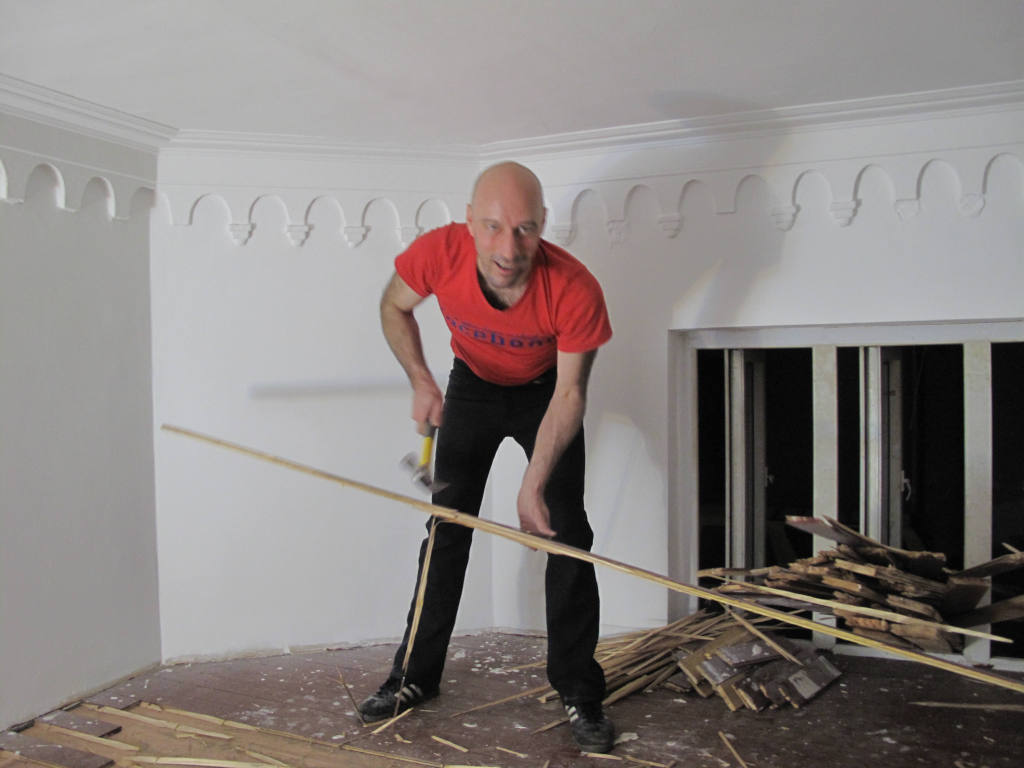
The nail has been in the wood for thirty years. Pulling it out might take thirty seconds—and yet it’s the antithesis of efficiency in the modern sense. It requires patience, judgment, and a feel for the material. In an age where digital perfection is becoming a mass-produced commodity, the human imperfection—the marks of craftsmanship, the patina, the incompleteness—is no longer a deficiency. It’s a scarce resource. And scarcity, as the market knows, creates value.
Labor Model Innovation and the Role of Manual Work
Rethinking the Skilled Labor Requirement
The construction industry’s persistent characterization of its labor problem as a skills shortage misframes a more complex structural challenge. What is actually scarce is not manual labor per se, but specific certified trades that have become gatekeepers for tasks that, in a differently organized production system, could be executed by semi-skilled workers following well-designed assembly procedures (Gann, 1996). Design for Manufacture and Assembly (DfMA) and prefabrication strategies are, in part, strategies for redesigning the construction process so that a larger proportion of the work can be performed by workers with general manual competence rather than specialized trade credentials.
Reorganizing when and where skill is applied—concentrating it in factory environments and reducing its required intensity on site—is a structural cost reduction strategy of significant magnitude (Gibb & Isack, 2003; Blismas & Wakefield, 2009). This is further supported by the upcoming ubiquity of construction automation and robotics, which standardize quality and safety (Bock, 2015).
Community and Self-Build Models
Among the most radical—and at the same time culturally significant—strategies is the direct participation of future residents in the construction process. In an age where digital perfection is becoming a mass-produced commodity, physically created form gains a different value: it is scarce, individual, and unrepeatable. Models such as the building group principle or cooperative frameworks take advantage of precisely this. Amateur workshops under professional guidance drastically reduce labor costs—and in doing so, create a connection to the place that no standardized product can achieve.
The economic logic is straightforward: in a conventional residential development, the developer’s margin, the construction contractor’s margin, and the profit embedded in subcontractor rates collectively add 25–40% to the base cost of construction. Community self-build projects eliminate or substantially compress all three. Where these conditions can be met, documented projects in Germany and Austria have delivered completed dwellings at 30–50% below comparable market-rate construction costs. The proof of concept is not new: architect Walter Segal’s self-build scheme in Lewisham, London, delivered structurally sound timber-framed homes in the late 1970s using residents with no prior building experience, all construction executed through dry-jointed bolted connections and standard-size panels that eliminated every wet trade from the process (World Habitat, 1981).
Cooperative Procurement and Economies of Scale
The fragmentation of residential construction procurement systematically forfeits the economies of scale that make factory production and long-run supply chain partnerships viable. Cooperative procurement frameworks, in which multiple housing associations, municipalities, or private developers aggregate their demand and procure construction services collectively, can achieve material cost reductions of 10–20% through bulk purchasing and can create the volume certainty that factory operators and specialist subcontractors need to invest in productive capacity (Gibb & Isack, 2003).
Systemic Interventions and the Regulatory Environment
Simplified Planning and Permitting
Building permit processes in most European jurisdictions impose time costs that are rarely quantified but are substantial in practice. For a developer carrying land acquisition finance at 4–6% annual interest, a 12-month planning delay on a 100-unit scheme can add EUR 800,000–1,200,000 to the cost of the project before a single brick is laid. Streamlining permitting processes would directly reduce these financing cost burdens.
Toward an Integrated Cost Reduction Agenda
The evidence argues against waiting for a single technological breakthrough. The tools are already available; what’s lacking is the strategic coherence and the institutional will to use them systematically.
The strategies discussed here, when combined, enable a reduction in base costs of 30–50%: Adaptive repurposing and recycling utilize existing resources instead of destroying them (Wolfe, 2023). Design for Manufacturing (DfMA) and prefabrication shift labor to more productive environments. Cooperative procurement creates economies of scale that fragmented individual projects will never achieve. This triad—design-related, economic, and ecological—requires a shift in thinking that goes beyond technology.
The real obstacle is conceptual. Why does the construction industry remain organized as a series of individual projects, while almost every other industrial product has long since transitioned to mass production? Why is demolition considered destruction when selective deconstruction conserves resources and preserves value? Why are residents seen as passive consumers instead of active participants whose physical contribution gives the product identity—and thus a value that digital technology cannot replicate?
Rigidly pursuing these questions is the most important task for current building research. The economic pressure is well-known. The tools are available. What is lacking is the will to provide a systemic solution.
A Note on Professional Partnership
Translating the strategies outlined in this essay from argument into built reality requires more than technical knowledge—it requires an architect who has genuinely internalized different cultural frameworks for how buildings are conceived, budgeted, and delivered. Ansgar Halbfas brings precisely this breadth of formation. His professional experience in China exposed him to a construction culture defined by speed, material pragmatism, and an unsentimental willingness to experiment at scale—a context in which theoretical elegance yields immediately to the question of what can actually be built, at what cost, and by next quarter. Chinese construction culture demands that architects operate as integrators of the full delivery system, not as authors insulated from procurement reality, and that disposition is visible in how Halbfas approaches a brief.
His subsequent engagement with American practice added a complementary dimension: the US tradition of common-sense value engineering, direct client communication, and a results-oriented professionalism that has little patience for process as an end in itself. Where European architectural culture sometimes privileges formal and regulatory procedure over outcome, the American context trains architects to ask, bluntly and usefully, whether a given decision is actually earning its cost. The synthesis of these two international formations—Chinese pragmatism about production and American directness about value—sits alongside Halbfas’s Central European design literacy in a combination that is unusual and genuinely suited to the challenge this essay describes.
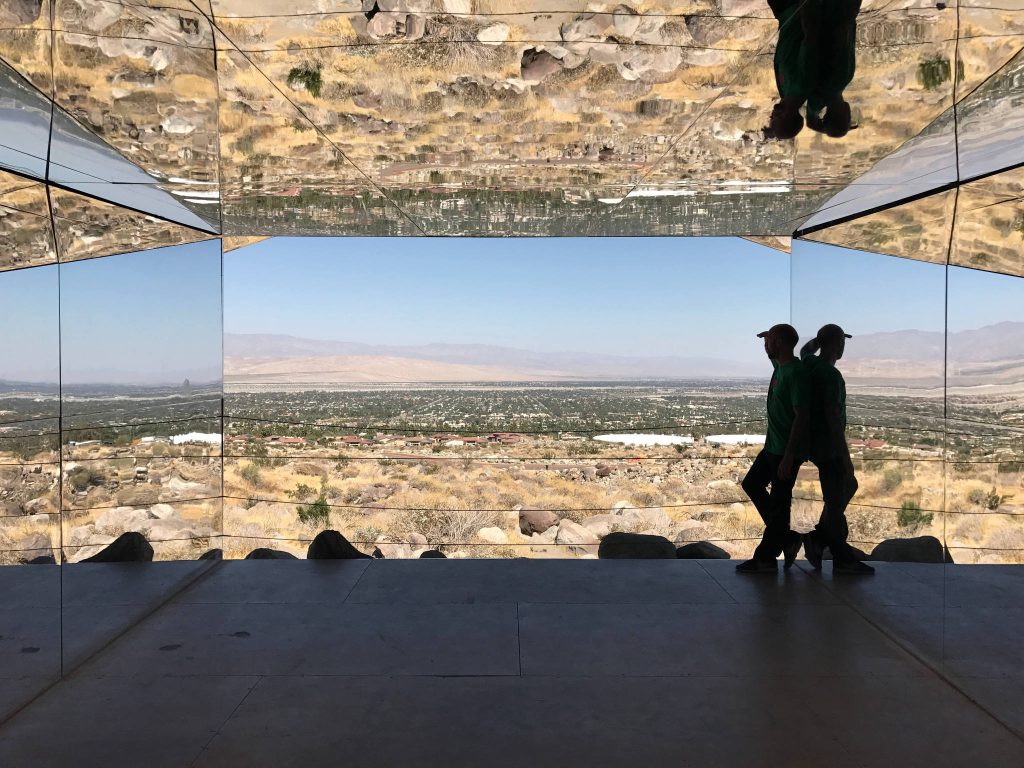
Ansgar Halbfas leading a guided architectural tour in Palm Springs, USA.
Selected references and further reading
Blismas, N. & Wakefield, R. (2009). Drivers, constraints and the future of offsite manufacture in Australia. Construction Innovation, 9(1), 72–83.
Bock, T. (2015). The future of construction automation: technological disruption and the upcoming ubiquity of robotics. Automation in Construction, 59, 113–121.
Chetty, R. et al. (2016). The effects of exposure to better neighborhoods on children: New evidence from the Moving to Opportunity experiment. American Economic Review, 106(4), 855–902.
Crowther, P. (2005). Design for disassembly—Themes and principles. RAIA/BDP Environment Design Guide, 1–7.
Durmisevic, E. (2006).Transformable building structures: Design for disassembly as a way to introduce sustainable engineering to building design & construction. TU Delft.
Ellen MacArthur Foundation (2019). Completing the picture: How the circular economy tackles climate change. EMF.
Gann, D.M. (1996). Construction as a manufacturing process? Similarities and differences between industrialized housing and car production in Japan. Construction Management and Economics, 14(5), 437–450.
Gibb, A.G.F. & Isack, F. (2003). Re-engineering through pre-assembly: client expectations and drivers. Building Research & Information, 31(2), 146–160.
Habermas, J. (1962). Strukturwandel der Öffentlichkeit. Untersuchungen zu einer Kategorie der bürgerlichen Gesellschaft. Frankfurt am Main: Suhrkamp.
Karp, A. C., & Zamiska, N. W. (2025). The technological republic: Hard power, soft belief, and the future of the West. Penguin Random House.
ISO 11228-2:2007. Ergonomics, Manual handling, Part 2: Pushing and pulling.
Paduart, A. et al. (2013). Renovation through redesign: Stimulating a mindset of building material reuse. Structural Survey, 31(1), 44–55.
Ratti, C. & Claudel, M. (2016). The city of tomorrow: Sensors, networks, hackers, and the future of urban life. Yale University Press.
Schmidt, R. & Austin, S. (2016).Adaptable architecture: Theory and practice. Routledge.
Wolfe, K. (2023). Mass timber and the future of the low-carbon building economy. Journal of Green Building, 18(2), 1–24.
World Habitat. (1981). Walter Segal Self-Build Housing Project, Lewisham. World Habitat Awards.
