Traditional student housing in Germany often suffers from what might be called administrative uniformity: a built environment shaped less by the people who will live in it than by regulatory systems that have accumulated their own logic over decades. This is not an accident of bad design. It is, as the philosopher Jürgen Habermas identified in his analysis of modern architecture, the result of buildings being delivered less and less in response to genuine social need, and more and more in response to what he called “system imperatives”—the demands of market efficiency and administrative procedure that override the intentions of any individual actor (Habermas, 1981). Our project breaks with this convention by establishing a research collegium that functions as a physical catalyst for innovation.
In doing so, we follow the principle of antidisciplinarity, as coined by the MIT Media Lab: “Innovation happens when we step out of our silos and work together in a way that is truly antidisciplinary” (Ito & Howe, 2016).
Innovation as an Architectural Foundation
While most construction projects follow a linear path of established norms, this building serves as a functional showcase for Non-Linear Building. The project implements solutions that categorically shift the status quo of German construction processes:
- Modular Evolution: Specific sections function as test cells for experimental materials. This corresponds to the Living Lab approach, where the building is understood as a learning system.
- The Renaissance of the “Master Builder”: The unity of design and execution—with Ansgar Halbfas personally taking an active role—is a conscious return to the Master Builder philosophy. The direct link between theoretical planning and technical precision by the developer overcomes the efficiency paradox of modern, fragmented construction processes. As demonstrated by the Jim Vlock Building Project at the Yale School of Architecture, a direct understanding of tectonics is essential for resilient architecture.
- Technological Symbiosis: The targeted use of specialized machinery within a craftsmanship context enables an individualization of architecture that exceeds the possibilities of industrial mass production.
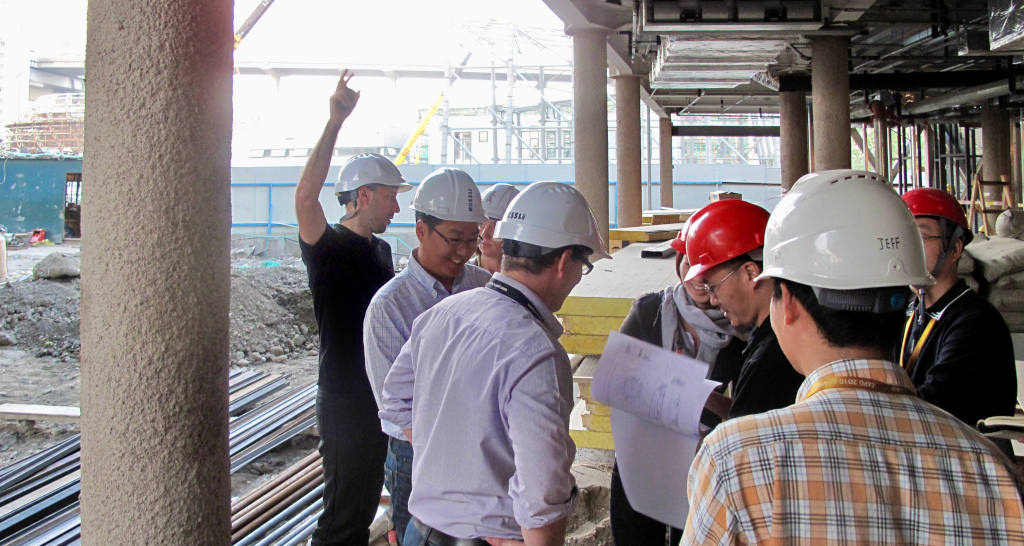
Ansgar Halbfas (left of frame) conducts research on affordable housing—critically and systematically: Where do funds disappear? What structures drive up costs? The goal is to develop methods to reduce construction costs at the inflation-adjusted level of 1985—a target he argues is still achievable. Because the strategies are known but rarely implemented, he also builds directly—to document exactly where theory meets resistance.
Regulatory Resilience and Avoiding Bureaucratic Dead Ends
The administrative rigidity encountered by experimental building in Germany is no coincidence, but the result of institutional path dependency. Nobel laureate Douglass North describes in his theory of institutional change how historical regulatory systems can actively hinder contemporary innovation (North, 1990). Habermas made a parallel diagnosis from a different angle: the problems of urban planning and construction, he argued, are not primarily problems of design but “problems of control, problems of containing and managing the system imperatives that penetrate the urban lifeworld and threaten to consume its urban substance” (Habermas, 1981, paraphrased in Trüby, 2026). In other words, the obstacles this project encounters—case-by-case approval requirements, the logic of the professional chamber system, the institutional primacy of precedent—are not bureaucratic accidents but structural features of a system that was not designed to accommodate buildings that think.
Model of Institutional Path Dependency
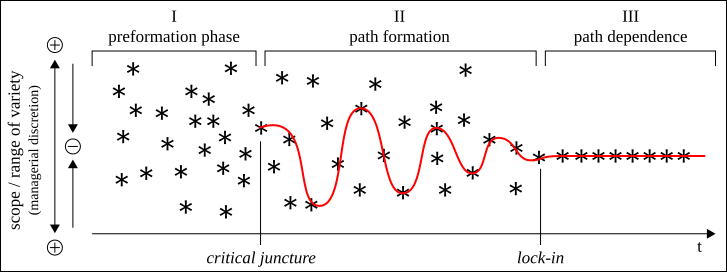
Based on the theories of Douglass C. North (Institutions, Institutional Change and Economic Performance, 1990).
Critical Juncture: The historical moment when fundamental decisions regarding building codes and regulations were established (e.g., early 20th-century standardization).
Self-Reinforcing Mechanisms (Increasing Returns): As industry, education, and administration align with the chosen path, it becomes dominant. Alternative methods (such as circular construction) become increasingly expensive and bureaucratically difficult to implement.
Lock-in Phase: The stage where the institutional framework becomes so rigid that innovation is only possible through extraordinary effort or radical redesigns (like this research collegium) that operate outside the conventional trajectory.
Construction as a Strategic Weakness
The failure to build affordably is not merely an administrative inconvenience—it is a civilizational vulnerability. Housing insecurity, stagnating infrastructure, and the institutionally enforced impossibility of construction innovation are not technical problems awaiting technical fixes. They are political failures with strategic consequences. When a society cannot produce shelter at a cost that working people can absorb, it is not simply an economic inefficiency: it is evidence that the social contract is fraying at the seams most people depend on.
Economist Alain Bertaud has demonstrated that the dominant driver of urban housing costs is not material or labor expense, but regulatory constraint—particularly the artificial suppression of buildable land and the procedural friction that extends project timelines far beyond any technical necessity (Bertaud, 2018). In the German context, where Bauordnungsrecht, Vergaberecht, and the certification requirements of the Kammersystem compound upon one another, the result is a construction apparatus that consumes resources in compliance rather than creation. The consequence falls not on institutions, but on individuals—on the researcher who cannot afford to live near her university, on the apprentice priced out of the city where his training takes place.
This project does not treat that condition as an immovable background reality. It treats it as a solvable engineering problem—and builds accordingly.
Software as the Missing Infrastructure
Construction is one of the last major industries without a software-defined core. The productivity stagnation that has characterized the built environment sector since the 1960s—documented by McKinsey Global Institute (2017) as among the worst of any major industry—is inseparable from this fact. While manufacturing, logistics, and finance have each undergone radical restructuring through digitization, construction has largely remained a paper-and-phone industry in a fiber-optic world.
The implication is not simply that efficiency gains are being left on the table. It is that whoever builds the software layer for construction—whoever writes the tools that model, simulate, permit, procure, and assemble buildings—will define what gets built, at what cost, and for whom. BIM (Building Information Modeling) in its current form is largely captured by a small number of incumbent platforms whose commercial incentives are misaligned with open interoperability. AI-assisted permitting navigation, parametric design optimization, and digital material passports remain fragmented and under-resourced. This is not a niche research question. It is the central infrastructure challenge of the built environment in the next two decades. This research collegium intends to be a place where that question is taken seriously—tested against real buildings, real materials, and real regulatory constraints.
The Moral Obligation of the Engineering Elite
There is a version of research that contents itself with publication—that measures its impact in citation counts and conference proceedings, and considers its obligations discharged when the paper clears peer review. This platform is built on a different premise. The engineering and scientific community in Germany and across Europe has accumulated extraordinary intellectual capital—much of it funded by public institutions, built on public infrastructure, and intended, however distantly, for public benefit. That capital carries obligations that a journal article does not fulfill.
The specific obligation that concerns us here is applied: closing the gap between what is technically known and what is actually built. The science of construction cost reduction, circular material procurement, and modular assembly is not speculative. The techniques are largely understood. What is missing is the demonstrated proof—the in-situ evidence, gathered under real operating conditions, that converts theoretical possibility into institutional permission. Testing at this site is, in this sense, an act of translation: between the laboratory and the construction site, between the research paper and the planning authority, between what is possible and what gets approved.
Science that does not travel this distance remains, however elegant, a private achievement. We are interested in the other kind.
References and further reading
Acs, Z. J. (2002). Innovation and the growth of cities. Edward Elgar Publishing.
Braungart, M., & McDonough, W. (2002). Cradle to cradle: Remaking the way we make things. North Point Press.
BBSR (2025). Wohnraumversorgung und Wohnraumbedarfe von Studierenden und Auszubildenden. Online-Publikation 46/2025.
Habermas, J. (1981). Moderne und postmoderne Architektur. In: de Bruyn, G. & Trüby, S. (Hrsg.) (2003). Basel: Birkhäuser.
Ito, J., & Howe, J. (2016). Whiplash: How to survive our faster future. Grand Central Publishing.
North, D. C. (1990). Institutions, institutional change and economic performance. Cambridge University Press.
Trüby, S. (2026). Jürgen Habermas als Architekturtheoretiker. Marlowes.de, April 2026.
Yale School of Architecture. (2023). The Jim Vlock first-year building project: Architecture and social responsibility. Yale University Press.
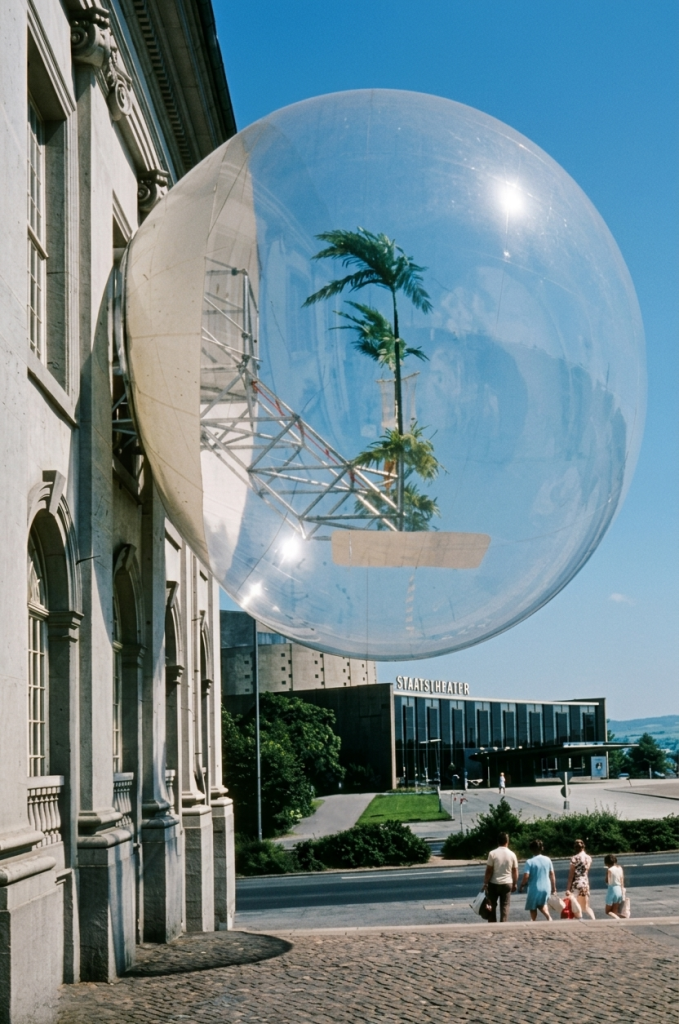
Rooted in a synthesis of scientific and engineering principles, Oase No. 7 (Haus-Rucker-Co, Kassel, 1972) is a prime example of experimental building and pneumatic architecture. The massive, transparent PVC sphere, suspended from the classical facade of the Museum Fridericianum, functions as a self-contained microcosm. Utilizing advanced material science for its synthetic membrane and precise structural engineering to ensure stability, it encloses a controlled environment containing real palm trees.
The project was not simply a visual statement but an experimental pilot study, applying data from environmental science (climatology, ecosystem dynamics) and early social-psychological research to test the feasibility of alternative, technologically mediated urban habitats. It sought to create an adaptable, climate-controlled ‘oasis’ for social interaction, probing the potential of new technologies to solve ecological and societal challenges through the design of a built environment grounded in emerging scientific knowledge.
Latest insights and behind-the-scenes: Keeping you up to date ↗︎
Foundation & Folklore: Notes on building, design, and belonging ↗︎
