Reclaimed Materials, Circular Procurement, and Adaptive Reuse
The Undervalued Resource of the Existing Building Stock
European building demolition generates approximately 900 million tonnes of construction and demolition waste annually, the majority of which is downcycled into low-value applications such as road sub-base or landfill. This represents a profound market failure (Ellen MacArthur Foundation, 2019). Structural timber, masonry units, roof tiles, sanitary ware, internal joinery, staircases, structural steel sections, and facade elements removed from buildings are in many cases fully serviceable and could be redeployed at a fraction of the cost of equivalent new materials—if procurement systems were organized to capture them.
Selective demolition—also termed deconstruction—is the practice of carefully dismantling buildings in a sequence that preserves the reuse value of their components, rather than simply demolishing and crushing the fabric (Durmisevic,2006). It is more labor-intensive than conventional demolition (typically by a factor of two to three), but recoversmaterials whose value, in a well-organized market, substantially exceeds the additional labor cost. In countries where this market is emerging—notably the Netherlands, Belgium, and to a lesser extent Germany—reclaimed structural timber can be sourced at 40–70% of the cost of equivalent new material; reclaimed clay roof tiles at 20–50%; and reclaimed steel sections at 30–60% savings relative to new.
Circular Procurement and Digital Material Passports
The principal barrier to scaled reclaimed material markets is information: buyers cannot reliably know what materials are available, in what quantities, in what condition, and with what performance specifications. Digital material passports—structured data records associated with building components that record their material composition, structural properties, and maintenance history—are emerging as the key enabling technology for circular construction procurement (Paduart et al., 2013). When components are tagged at installation (using RFID, QR codes, or other identification systems) and their passport data is maintained through building management systems, they become identifiable and specifiable assets in secondary markets.
As passport data accumulates, AI-assisted matching platforms—analogous to existing timber or steel commodity exchanges—could route reclaimed materials efficiently to projects where they are most suitable, transforming what is currently a fragmented, informal secondary market into a functional, scalable supply chain for residential construction (Ratti & Claudel, 2016).
Adaptive Reuse of Non-Residential Buildings
The conversion of redundant non-residential buildings—commercial offices, retail stores, industrial warehouses, car parks—into residential accommodation offers a route to housing production that substantially avoids the cost of new structural construction (Schmidt & Austin, 2016). The existing structure, envelope, and frequently the building services infrastructure of such buildings can be retained and repurposed, with new residential fit-out inserted within the existing shell. In well-documented conversion projects, the structural and envelope costs that typically account for 30–40% of new residential construction budgets are largely eliminated, replaced by the (usually lower) cost of modification and adaptation.
Several documented conversion projects in London, Amsterdam, and Paris have demonstrated that office-to-residential conversion can deliver completed units at 15–35% below the cost of equivalent new residential construction on the same site.
Labor Model Innovation and the Role of Manual Work
Rethinking the Skilled Labor Requirement
The construction industry’s persistent characterization of its labor problem as a skills shortage misframes a more complex structural challenge. What is actually scarce is not manual labor per se, but specific certified trades that have become gatekeepers for tasks that, in a differently organized production system, could be executed by semi-skilled workers following well-designed assembly procedures (Gann, 1996). Design for Manufacture and Assembly (DfMA) and prefabrication strategies are, in part, strategies for redesigning the construction process so that a larger proportion of the work can be performed by workers with general manual competence rather than specialized trade credentials.
Reorganizing when and where skill is applied—concentrating it in factory environments and reducing its required intensity on site—is a structural cost reduction strategy of significant magnitude (Gibb & Isack, 2003; Blismas & Wakefield, 2009). This is further supported by the upcoming ubiquity of construction automation and robotics, which standardize quality and safety (Bock, 2015).
Community and Self-Build Models
Among the most radical and most frequently overlooked strategies for residential cost reduction is the direct participation of future residents in the construction of their own homes. The self-build and community build models demonstrate that amateur labor, when properly organized and supervised, can contribute meaningfully to construction outputs at a labor cost close to zero.
The economic logic is straightforward: in a conventional residential development, the developer’s margin, the construction contractor’s margin, and the profit embedded in subcontractor rates collectively add 25–40% to the base cost of construction. Community self-build projects eliminate or substantially compress all three. Where these conditions can be met, documented projects in Germany and Austria have delivered completed dwellings at 30–50% below comparable market-rate construction costs.
Cooperative Procurement and Economies of Scale
The fragmentation of residential construction procurement systematically forfeits the economies of scale that make factory production and long-run supply chain partnerships viable. Cooperative procurement frameworks, in which multiple housing associations, municipalities, or private developers aggregate their demand and procure construction services collectively, can achieve material cost reductions of 10–20% through bulk purchasing and can create the volume certainty that factory operators and specialist subcontractors need to invest in productive capacity (Gibb & Isack, 2003).
Systemic Interventions and the Regulatory Environment
Simplified Planning and Permitting
Building permit processes in most European jurisdictions impose time costs that are rarely quantified but are substantial in practice. For a developer carrying land acquisition finance at 4–6% annual interest, a 12-month planning delay on a 100-unit scheme can add EUR 800,000–1,200,000 to the cost of the project before a single brick is laid. Streamlining permitting processes would directly reduce these financing cost burdens.
Toward an Integrated Cost Reduction Agenda
What the evidence does not support is the conclusion that cost reduction in residential construction must await a single technological breakthrough. Reducing residential construction costs is not a problem of insufficient technology—it is a problem of insufficient integration.
The strategies discussed in this essay collectively represent a potential 30–50% reduction in the baseline cost of residential construction, achievable with combinations of approaches that are already technically proven. Reclaimed materials and adaptive reuse redirect existing resources away from waste (Wolfe, 2023), while DfMA and prefabrication shift labor to more productive environments. Pursuing the implications of these questions rigorously represents the most important intellectual task for the construction research community in the years ahead.
A Note on Professional Partnership
Translating the strategies outlined in this essay from argument into built reality requires more than technical knowledge—it requires an architect who has genuinely internalized different cultural frameworks for how buildings are conceived, budgeted, and delivered. Ansgar Halbfas brings precisely this breadth of formation. His professional experience in China exposed him to a construction culture defined by speed, material pragmatism, and an unsentimental willingness to experiment at scale—a context in which theoretical elegance yields immediately to the question of what can actually be built, at what cost, and by next quarter. Chinese construction culture demands that architects operate as integrators of the full delivery system, not as authors insulated from procurement reality, and that disposition is visible in how Halbfas approaches a brief.
His subsequent engagement with American practice added a complementary dimension: the US tradition of common-sense value engineering, direct client communication, and a results-oriented professionalism that has little patience for process as an end in itself. Where European architectural culture sometimes privileges formal and regulatory procedure over outcome, the American context trains architects to ask, bluntly and usefully, whether a given decision is actually earning its cost. The synthesis of these two international formations—Chinese pragmatism about production and American directness about value—sits alongside Halbfas’s Central European design literacy in a combination that is unusual and genuinely suited to the challenge this essay describes.
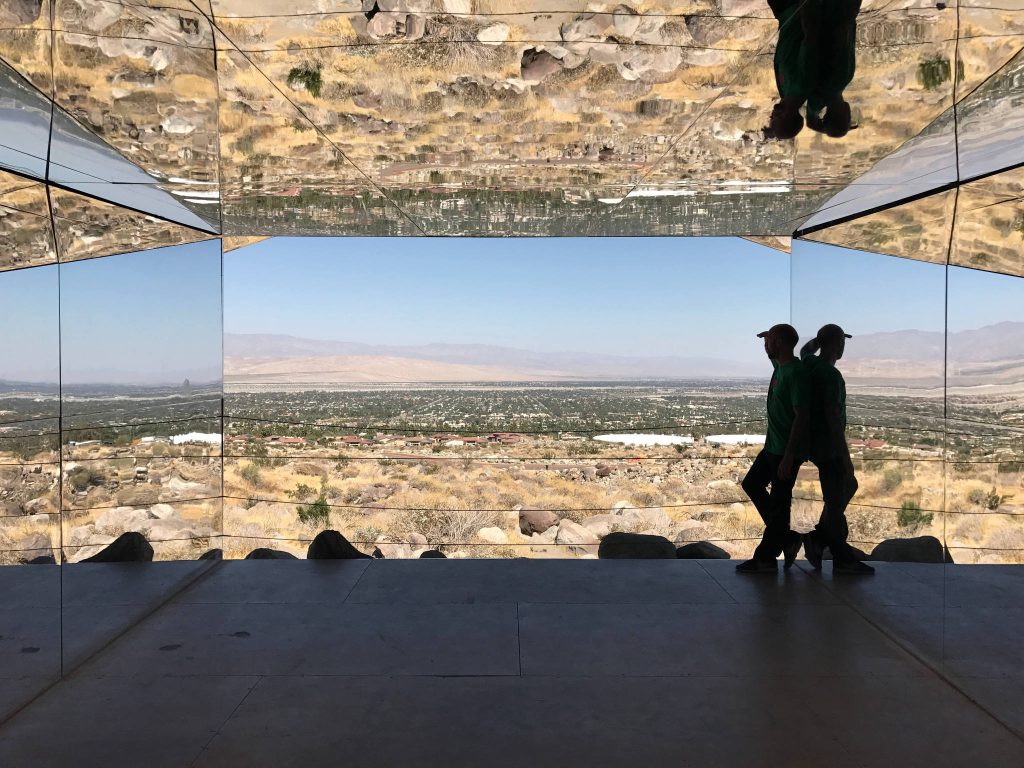
Ansgar Halbfas leading a guided architectural tour in Palm Springs, USA.
Selected References and Further Reading
Blismas, N. & Wakefield, R. (2009). Drivers, constraints and the future of offsite manufacture in Australia. Construction Innovation, 9(1), 72–83.
Bock, T. (2015). The future of construction automation: technological disruption and the upcoming ubiquity of robotics. Automation in Construction, 59, 113–121.
Durmisevic, E. (2006). Transformable building structures: Design for disassembly as a way to introduce sustainable engineering to building design & construction. TU Delft.
Ellen MacArthur Foundation (2019). Completing the picture: How the circular economy tackles climate change. EMF.
Gann, D.M. (1996). Construction as a manufacturing process? Similarities and differences between industrialized housing and car production in Japan. Construction Management and Economics, 14(5), 437–450.
Gibb, A.G.F. & Isack, F. (2003). Re-engineering through pre-assembly: client expectations and drivers. Building Research & Information, 31(2), 146–160.
Paduart, A. et al. (2013). Renovation through redesign: Stimulating a mindset of building material reuse. Structural Survey, 31(1), 44–55.
Ratti, C. & Claudel, M. (2016). The city of tomorrow: Sensors, networks, hackers, and the future of urban life. Yale University Press.
Schmidt, R. & Austin, S. (2016). Adaptable architecture: Theory and practice. Routledge.
Wolfe, K. (2023). Mass timber and the future of the low-carbon building economy. Journal of Green Building, 18(2), 1–24.
