The House of Sciences runs two practical research tracks where theory meets reality.
What happens on a construction site is, among other things, a social event. Jürgen Habermas opened a long passage in Theorie des kommunikativen Handelns (1981) with exactly this observation—a detailed analysis of an ordinary moment between construction workers: the experienced worker sending the newcomer to fetch drinks, the hierarchy embedded in the request, the temporal and spatial coordinates that define the situation, the way informal power operates through the language of practical instruction. His point was not anecdotal. It was that the most basic acts of coordination on a building site are already saturated with social structure—with what he called the “lifeworld,” the background of shared assumptions and relationships within which every action takes place (Habermas, 1981). This project takes that observation seriously. The building is a laboratory not just for materials and methods, but for the social processes that make building possible—or that, when they go wrong, make it impossible.
Real-World Prototyping & Construction
This program is for those who want to build, break, and improve. We use the house grounds as a laboratory for Applied Experimental Research, testing new construction methods and design ideas at a 1:1 scale. Instead of just drawing plans, we build them. We’re always looking for partners to help us execute our next round of on-site builds—check out our current prototypes below to see where you fit in.
The Resident Researcher Program
Our Immersive Academic Research track is for students who live on-site, turning the house into a 24/7 hub for personal projects, commissioned studies, and startup ideas. It’s multidisciplinary and fast-moving, designed to give the next generation of professionals the edge they need. We bridge the gap between industrial psychology, design, and management, focusing on areas like:
Brain-Friendly Spaces & Smart Privacy ↙︎
- Stress-Free Design: Finding ways to build rooms that actually make people feel better and work smarter.
- Hacking the Smart Home: Integrating tech into our living spaces without giving away all our data or losing our privacy.
- Tactile Environments & Focus: Testing how different textures, lighting setups, and room layouts can naturally boost concentration without needing “productivity” apps.
New-School Business & Career Survival ↙︎
- Post-Growth & Alternative Careers: Designing business models for people who want to work for themselves or in small, agile teams rather than massive corporations.
- The Skill-Stacking Lab: Researching how young pros can mix different talents (like coding + psychology + carpentry) to stay unreplaceable in a weird job market.
- Impact-First Ventures: Building businesses that actually solve a problem or help a community while still being profitable enough to scale.
Scrappy Building & Local Tech ↙︎
- Upcycling & Material Rebirth: Moving past “sustainability” by finding clever ways to repurpose demolition waste and existing materials into high-end architecture.
- Home-Grown AI: Developing localized intelligence for educational contexts and create smart tools for self-directed learning.
- Impact Entrepreneurship & Ethical Management: Analyzing business models that prioritize social and environmental responsibility alongside financial viability.
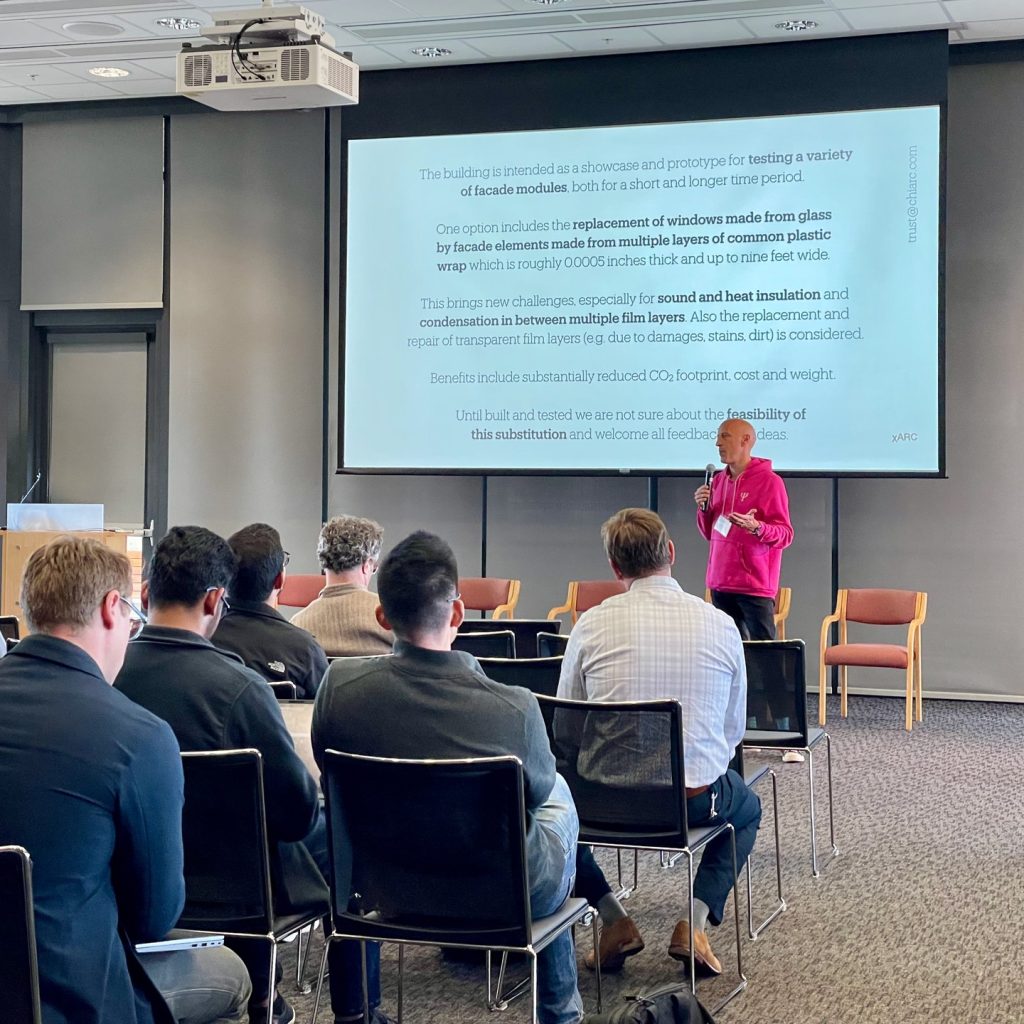
The building is intended as a showcase and prototype for testing a variety of facade modules, both for a short and longer time period. One option includes the replacement of windows made from glass by facade elements made from multiple layers of common plastic wrap which is roughly 0.0005 inches thick and up to nine feet wide. This brings new challenges, especially for sound and heat insulation and condensation in between multiple film layers. Also the replacement and repair of transparent film layers (eg. due to damages, stains, dirt) are to be considered. Benefits include substantially reduced embodied carbon, cost and weight. Since it is currently unclear whether the concept actually works in practice, Ansgar Halbfas suggests that doctoral students critically monitor the prototype construction in order to test its feasibility.
