A place to focus, come together, and share—with people who get it. Whether you’re deep in thesis mode, between lectures, or just need a good meal and a quiet corner, everything here is designed to make life a little easier and a lot more enjoyable. Log in to explore what’s yours:
Personal retreat
Your room is your sanctuary—your bed, your desk, your space to breathe. Need silence for a long call? A corner to think? It’s waiting for you. And when you want a change of scenery, the garden room is there for a night away from it all, wrapped in the quiet scent of herbs and spice plants. Or when family visits, the large room opens up—bright, spacious, the kind of space that makes guests feel genuinely at home.
Wellbeing
A shared kitchen with real ambition beats a corridor of mini-fridges and single hobs every time. We’re talking sharp Japanese chef’s knives and a full set of German steel, cast iron skillets that have earned their seasoning, a carbon steel wok, copper pots for the slow simmers, a mandoline, a stand mixer, a pasta machine—the kind of tools most people only encounter in restaurant kitchens. Cooking here is a different experience entirely.
The same philosophy applies to the bathrooms. One is pure function—clean, efficient, everything you need. Another is something more: a wide, well-lit mirror that’s genuinely good for a careful morning routine, space to spread out, a place where getting ready doesn’t feel rushed.
A little coordination keeps it all flowing. All of that happens here, online, so nobody’s ever left waiting.
Workspaces
Our architects and builders thought carefully about what people actually need—and made sure it’s available to everyone.
The tables are chosen for their purpose. Some are wide and sturdy, better for spreading out work, opening books, or working through printed drafts. Others are warmer, lower, meant for eating together or having a long conversation over coffee.
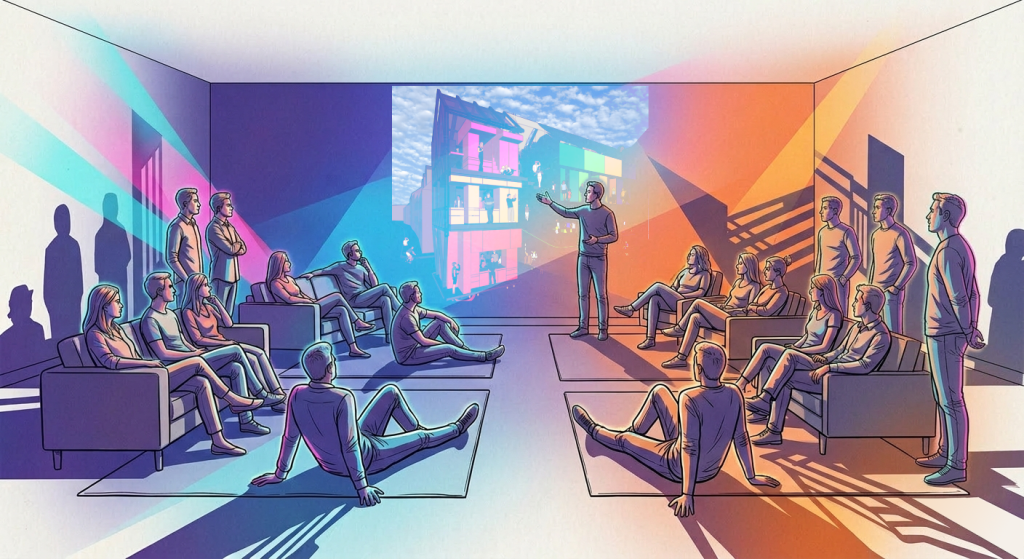
For digital work: a projector for presentations, large screens, reliable connections—everything you need to host a study group or run through a deck without scrambling for cables.
For making things: a full carpentry toolkit for anyone building, fixing, or creating. And for finishing printed work—a corner rounder for clean-edged handouts, binding tools, a paper trimmer—the small details that make a student project look considered rather than thrown together.
It’s the kind of workspace most students don’t encounter until well into a career. Here, it’s just part of living together.
“A room gives you a place to sleep. Living here gives you something more—a community that shares skills, resources, and the occasional home-cooked meal.”
Log in and make yourself at home:
From Root to Loom
Beyond the physical amenities, the House of Sciences is intentionally designed as a “living system” that nurtures collective wisdom and transformative learning. Our approach is informed by Barbara Widhalm’s (2025) research in her paper, The We-Ro’s Journey and the Art of Holding Space, which explores how intentional environments can foster “autopoietic developments” where groups generate insights that no individual could reach alone. We particularly recommend exploring her chapter on the fourteen qualities of holding space, which details specific strategies—from “Heart Space” for building caring connections to “Loom Space” for weaving individual genius into a shared tapestry—that we strive to embody within our research collegium. We encourage all residents and visitors to read the full paper to better understand the systemic principles that make our house a self-organizing forest of learning.
References
Widhalm, B. (2025). The We-Ro’s journey and the art of holding space: Creating conditions for collaborative learning forests. In J. Wilby, J. Makar, & G. Smith (Eds.), Journal of the International Society for the Systems Sciences | 69th Meeting of the International Society for the Systems Sciences.
