The index at the end of this page lists available documents, chronologically sorted into the categories drawings, sketches, documentation, and literature.
The Origins of 4-dimensional Planning
On their quest for the latest und most useful technology—beyond their standard curriculum—during the 1990’s Ansgar Halbfas and some classmates left the conveniently located K1 tower in Stuttgart midtown and traveled to the Vaihingen research campus where they found what they were looking for: Prototypes at the Fraunhofer Institute for Industrial Engineering (IAO) inspired them to early on work with 4D models containing actual and projected content, allowing for proactive collision detection and logistical optimization (Eastman et al., 2011). Digital Twins in form of a virtual model serve as a real-time reflection of the physical site’s progress and performance (Grieves & Vickers, 2017).
Circular Economy and Material Health
The cradle-to-cradle methodology defines the building as a material bank. This approach ensures that every component—from the structural timber to the finishes—is selected for its biological or technical capacity, effectively eliminating the concept of waste at the moment in future, when the building is disassembled and can easily be separated into it’s parts to build something new (Braungart & McDonough, 2002). “The process of dismantling has to be considered during the initial assembly to avoid waste and frustration during teardown. We are constantly updating a data bank with building specifications and modifications, accessible to future owners.”
Seven principles of connections ranged from fixed to flexible, originally developed by Elma Durmisevic in her 2006 doctoral thesis Transformable Building Structures. This diagram is a fundamental reference in Design for Disassembly and categorizes how building elements are joined, moving from permanent “fixed” bonds to highly “flexible” (removable) connections:
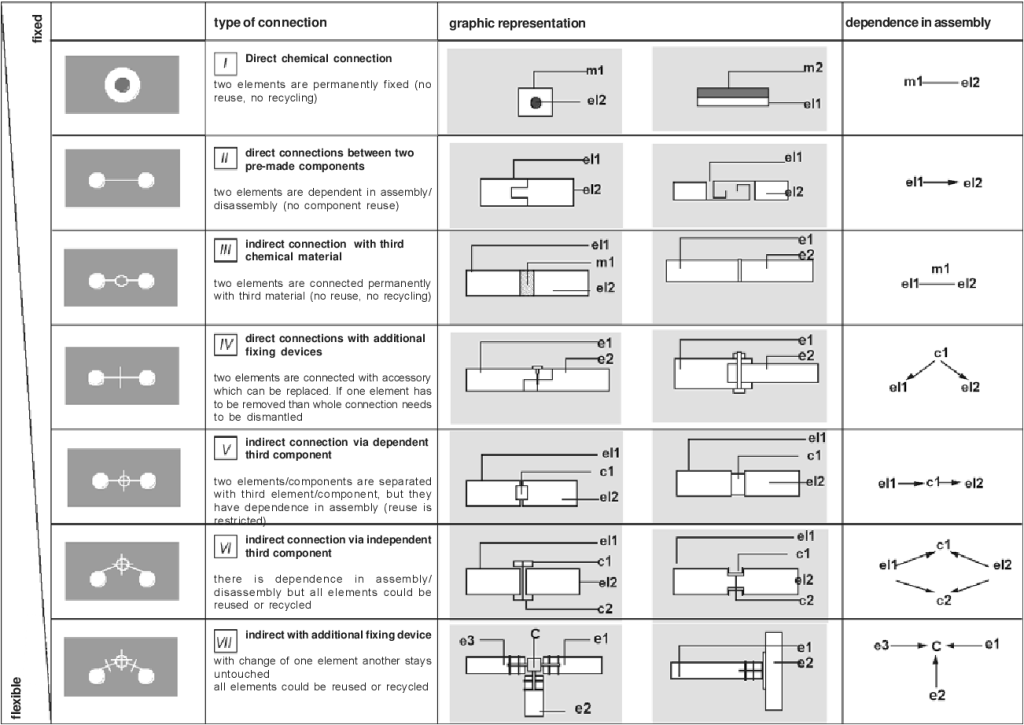
The seven principles are sorted from fixed (no reuse, no recycling) to flexible (all elements can be reused or recycled).
| Principle | Type of connection | Description |
| I (fixed) | Direct chemical connection | Two elements are permanently fixed (no reuse, no recycling). |
| II | Direct connections between two pre-made components | Two elements are dependent in assembly/disassembly (no component reuse). |
| III | Indirect connection with third chemical material | Two elements are connected permanently with third material (no reuse, no recycling). |
| IV | Direct connections with additional fixing devices | Two elements are connected with accessory which can be replaced. If one element has to be removed the whole connection needs to be dismantled. |
| V | Indirect connection via dependent third component | Two elements/components are separated with third element/component, but they have dependence in assembly (reuse is restricted). |
| VI | Indirect connection via independent third component | There is dependence in assembly/ disassembly but all elements could be reused or recycled. |
| VII (flexible) | Indirect with additional fixing device | With change of one element another stays untouched. All elements could be reused or recycled. |
Our commitment to design for disassembly is not one general concept but rather put together by many micro-decisions, like—for example—including the application of the Open structures (OS) grid/manual and similar modularity. The OS methodology uses a shared geometric grid to ensure that components are interoperable and can be easily replaced or repurposed by future users (Lommee, 2012). By adhering to this grid, the project transitions from a “fixed product” to an “evolving system.”
Our commitment to design for disassembly is built on many micro-decisions, including the application of the Open structures (OS) grid to ensure that components are interoperable and easily repurposed (Lommee, 2012). More essentially, this approach transforms the building into a self-bounded autopoietic network, where the structure acts as an integral boundary that is organizationally closed yet open to the flow of new ideas and materials. This allows the project to be self-generating and self-renewing, with components continually produced and replaced through internal transformation processes rather than conventional demolition. Through structural coupling, the house adapts by creating new structures in response to interactions with its environment and residents, facilitating ongoing learning and development (Capra, 1996). Ultimately, by prioritizing these systemic properties, the project transitions from a “fixed product” into a living, evolving system.
Unlike traditional standardized lumber, working with round timber requires algorithmic modeling to account for natural geometric irregularities (Menges et al., 2017).
Ansgar Halbfas analyzes local waste streams before they enter the linear take-make-dispose cycle, adapting designs to integrate materials available within the economy. When stopped by institutional and corporate rigidity which frequently prevented shipments of materials from being diverted to the site, resulting in avoidable disposal, Halbfas found that “material recovery is more successful when engaging directly with operational intermediaries rather than administrative management.“ Based on these insights, all future projects will strictly adhere to circular economy principles, prioritizing the regenerative use of resources to minimize environmental impact (Kirchherr et al., 2017).
Evidence-Based Design and Prototyping
To mitigate risks the project employs Evidence-Based Design through the creation of a Mockups. “The House of Sciences welcomes startup’s and research groups, to test their prototype modules and materials at our site centrally located within Germany. We are open to replace any existing element to your research module/material and compare it’s performance in situ. To maximize the scientific value, we share relevant performance data from before, during, and after the test phase” (A. Halbfas, personal communication). This physical prototyping allows to validate the hygrothermal and structural performance of new details before full-scale deployment (Ulrich et al., 2008).
The inclusion of work-based learning emphasizes multi-stakeholder education. This approach utilizes the construction site as a laboratory for professional development and cross-cultural technical exchange, ensuring that specialized knowledge is preserved and can evolve (Alcindor & Jackson, 2023).
A user-centric design process ensures that the final environment supports the psychological well-being of its occupants through biophilic design (Kellert, 2018).
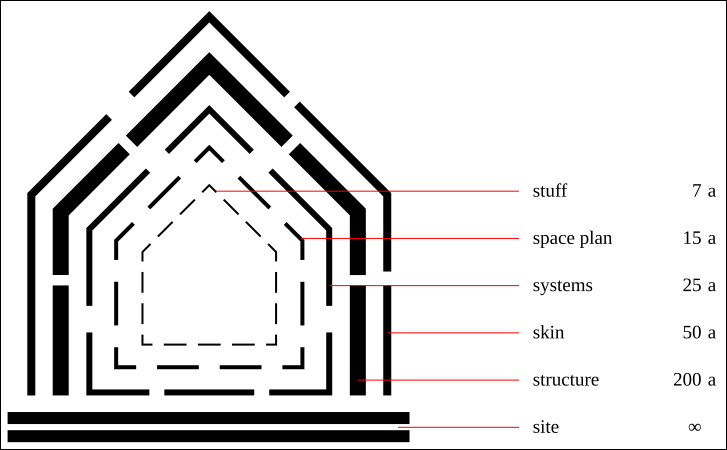
Building on the work of Duffy (1992), Brand (1994) expanded the shearing layers model to six distinct elements. This framework draws on hierarchies in ecology (O’Neill et al., 1986) and systems theory (Salthe, 1993), which posit that systems operating on disparate timescales remain functionally decoupled. Brand applied this to architecture, observing that adaptive capacity depends on the ‘slippage’—or independence—between layers. This ensures that short-cycle systems (Services) can be updated without compromising long-cycle systems (Structure). This principle, termed Pace-Layering (Brand, 1999), advocates for an architectural arrangement that maximizes modularity and long-term viability:
Pace layers ↙︎
- Site: This is the geographical setting, the urban location, and the legally defined lot, whose boundaries and context outlast generations of ephemeral buildings.
- Structure: The foundation and load-bearing elements are perilous and expensive to change, so people don’t. These are the building. Structural life ranges from thirty to three hundred years (but few buildings make it past sixty for other reasons).
- Skin: Exterior surfaces now change every twenty years or so, to keep up with fashion or technology, or for wholesale repair. Recent focus on energy costs has led to re-engineered skins that are air-tight and better-insulated.
- Services: These are the working guts of a building: communications wiring, electrical wiring, plumbing, fire sprinkler systems, HVAC (heating, ventilating, and air conditioning), and moving parts like elevators and escalators. They wear out or obsolesce every seven to fifteen years. Many buildings are demolished early if their outdated systems are too deeply embedded to replace easily.
- Space Plan: The interior layout, where walls, ceilings, floors, and doors go. Turbulent commercial space can change every three years or so; exceptionally quiet homes might wait thirty years.
- Stuff: Chairs, desks, phones, pictures; kitchen appliances, lamps, hairbrushes; all the things that twitch around daily to monthly. Furniture is called mobile in Italian for good reason.
Planning documents for the House of Sciences include a 4D model with actual and projected content, drawings on various topics, floor plans and sections. Depending on the detail and method of production, separate dimensioning data and types of documentation are applicable:
Drawings ↙︎
Sketches ↙︎
Documentation ↙︎
Literature ↙︎
- Using BIM to install structural round timber, PDF · German
- A short art history of German half-timbered buildings, PDF · German
- Work based learning in California, PDF
- Mood for Wood in Poland, the Czech Republic, Slovakia and Hungary
- Open structures grid/manual, PDF · 4.3
- Cradle-to-cradle standards, guidance und methodologies, PDF · 2024
- Building rules lists A, B, and C, PDF · German · 2015
- Technical Building Regulations, PDF · German · 2025
“Building on a budget shouldn’t mean building poorly. Our radical economy approach swaps off-the-shelf products for smart, circular designs and repurposed materials.“
— Ansgar Halbfas, 2023
A tight budget is a creative catalyst for frugal innovation: maximizing impact while minimizing resource use. (Radjou, 2013).
Knowledge Transfer: Strategy for Success
This isn’t just a project archive; it’s an open book. From enduring German building laws to mastering small-scale living, our insights are now your advantage. If you’re looking to build sustainably without breaking the bank, skip the learning the hard way phase. Use our strategies to fast-track your project and save your budget for what matters ↗︎
References
Alcindor, M., & Jackson, D. (2023). Transmitting culture through building systems: The case of the tile vault. Buildings, MDPI.
Brand, S. (1994). How buildings learn. Viking.
Brand, S. (1999). Clock of the long now.
Braungart, M., & McDonough, W. (2002). Cradle to cradle: Remaking the way we make things. North Point Press.
Duffy, F. (1992). The changing workplace. Phaidon Press.
Capra, F. (1996). The web of life: A new scientific understanding of living systems. New York, NY: Anchor Books.
BIM handbook: A guide to building information modeling. Wiley.
Grieves, M., & Vickers, J. (2017). Digital twin: Mitigating unanticipated outcomes in complex systems. Digital Twin (pp. 85–113). Springer.
Kellert, S. R. (2018). Nature by design: The practice of biophilic design. Yale University Press.
Kirchherr, J., Reike, D., & Hekkert, M. (2017). Conceptualizing the circular economy. Resources, Conservation and Recycling.
Lommee, T. (2012). The open structures grid manual. OS Foundation.
Maturana, H. R., & Varela, F. J. (1991). Autopoiesis and cognition: The realization of the living. New York, NY: Springer.
Eastman, C. et al. (2011).
Menges, A., Schwinn, T., & Krieg, O. D. (2017). Advancing wood architecture: A computational approach. Routledge.
O’Neill, R. V. et al. (1986). A hierarchical concept of ecosystems. Princeton University Press.
Radjou, N., Prabhu, J., & Ahuja, S. (2013). Jugaad innovation: Think frugal, be flexible, generate breakthrough growth. South Asian Journal of Global Business Research.
Salthe, S. N. (1993). Development and evolution: Complexity and change in biology. MIT Press.
Ulrich, R. S., et al. (2008). A review of the research literature on evidence-based design. HERD: Health Environments Research & Design Journal.
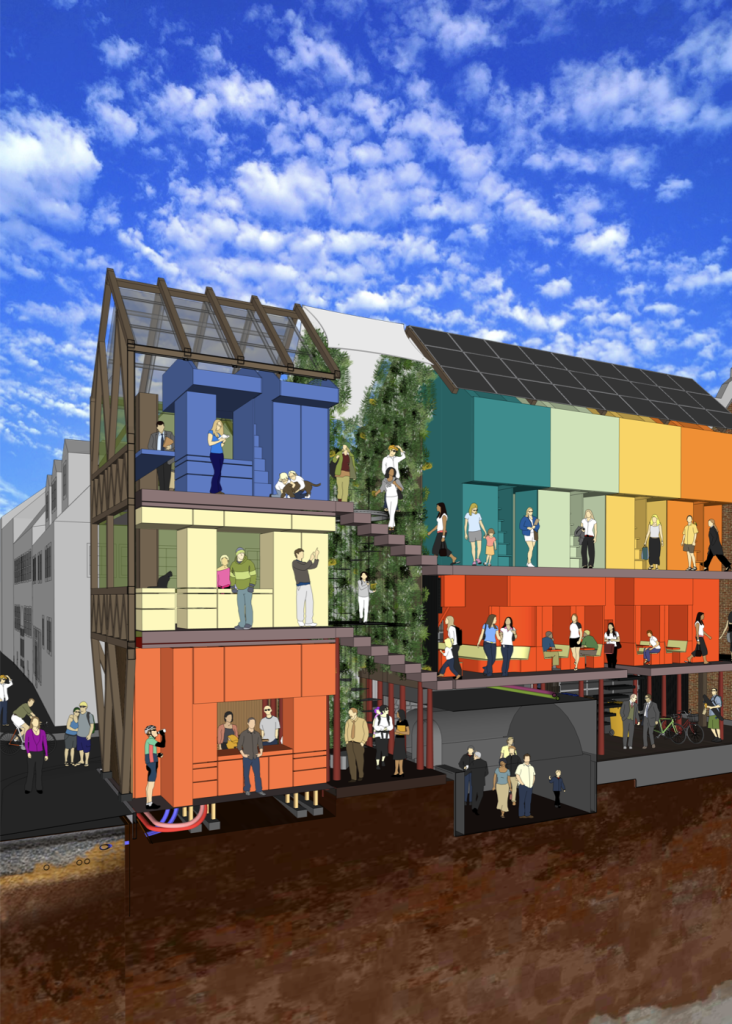
Spatial Organization and Functional Distribution
Level A (Vaulted cellar & Street): A multipurpose subterranean space equipped for digital presentations and guest hosting. The street level features an external-facing service pod for social interaction and a dedicated workshop for bicycle maintenance and technical projects.
Communal Zones (B): These floors centralize shared infrastructure. This includes the communal kitchen and dining area designed for professional-grade food preparation and international culinary exchange.
Residential Units (C): The upper levels consist of individual private rooms optimized for quiet study and rest.
Building Core: A vertical garden provides dedicated space for quiet reflection and botanical cultivation.
Operational Strategy
The layout centralizes high-resource amenities—such as housecrafts and technical workspaces—on the lower floors, while situating private residential quarters on the upper levels to balance community engagement with individual academic focus.
