This easy-to-understand summary is suited for students and language learners. The content has been condensed and scientific references have been omitted. The full context can be found in the complete version in standard language →
Research shows that students who live and study together in shared communities do better in school. They get higher grades, stay enrolled longer, and are more involved in their studies. This is not a coincidence—the way the community is set up makes the difference.
Living together also helps students feel like they belong. This feeling of belonging is important for mental health and happiness. Studies confirm these benefits last over time, even when you account for students’ different backgrounds and abilities.
The House of Sciences brings this idea to life today. It combines living together with a working culture similar to what you find at top universities and innovation hubs—like Stanford, ETH Zurich, or Oxford. The key values are personal responsibility, working as equals, and building real connections with each other.
Open Thinking and Understanding the Economy
The House of Sciences is designed for ambitious people with a global outlook. It works best when members hold each other to high standards.
The core idea is understanding how economies change. The economist Schumpeter described how new ideas constantly replace old ones—old industries die, new ones grow. This idea, called “creative destruction,” shapes how residents think about their business and research work. The house gives them the tools and space they need.
Location and Global Connections
Meiningen sits in the geographic center of Germany—a practical, well-connected location.
Global home base: For German entrepreneurs living abroad, it offers a permanent home base in Germany with a real address and full infrastructure.
International launchpad: For young people starting out, it is a good base for building projects in markets like the US or China.
Frankfurt, Munich, Stuttgart, and Berlin are all reachable by train or road. Train travel is not wasted time—research shows it is good for thinking, focus, and mental wellbeing.
Why Meiningen? The Science Behind the Location
Researchers at the Technical University of Kaiserslautern ran a detailed analysis to find the best possible location for a city in Germany—ignoring existing cities and starting from scratch. They looked at things like:
- Central location: easy to reach from anywhere in the country.
- Geography and resources: good water, soil, and natural conditions.
- Climate and quality of life: favorable weather and outdoor access.
Their study, called “Q-City,” identified Meiningen as the optimal point. The study was commissioned by a German public science TV program.
The Building and How It Works
The house has dedicated work areas, a library, fast internet, and a well-equipped shared kitchen. These are not extras—they are tools for serious work.
Research confirms that the physical environment directly affects how well people think. A Harvard study found that people in rooms with good air quality scored up to 61% higher on thinking tests. A large review of 66 studies confirmed that air quality, temperature, noise, light, and acoustics all affect performance—in different ways depending on the task. The house is designed with all of this in mind.
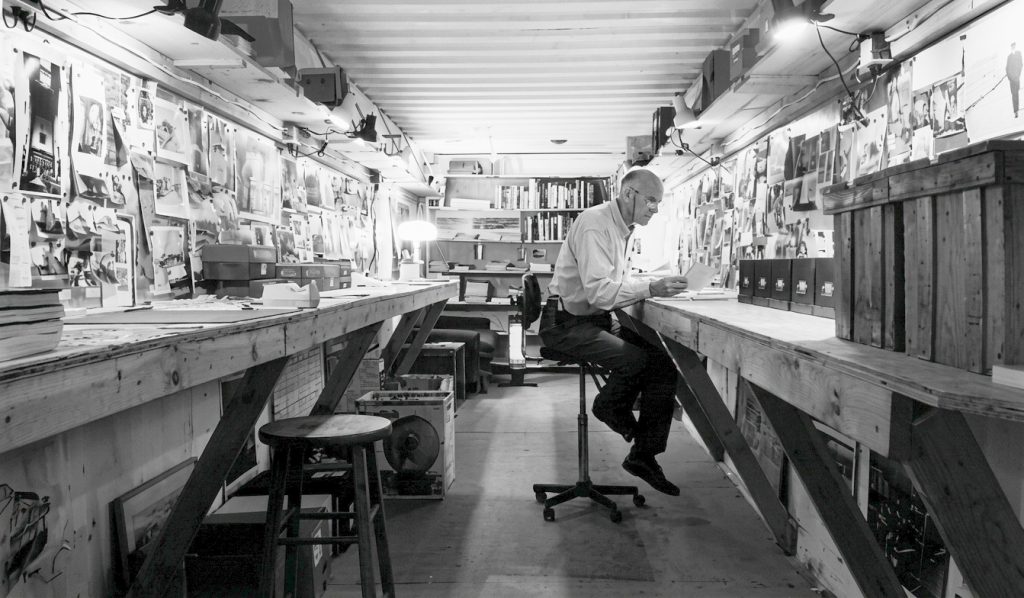
February 1993 | The workspace as a tool of Creative Destruction. Writer and publisher Stewart Brand once worked from a shipping container fitted out as a personal library—compact, functional, and entirely his own. The House of Sciences follows the same logic: a focused, low-cost environment where digital work and hands-on research happen side by side. The spaces are built to be changed and reused over time — updated without losing their character.
Nearby Universities and Research Centers
The region around Meiningen has a surprising number of universities and research institutions:
- Schmalkalden (~30 min.): Computer science, robotics, and commercial law.
- Bad Neustadt (~60 min.): Electric mobility and digital health.
- Ilmenau & Jena (~90 min.): Optics, photonics, medical technology—home to global companies like ZEISS and Jenoptik.
- Coburg & Schweinfurt (regional): Automotive engineering, hydrogen technology, and international management.
Living costs are moderate. This means residents keep more of their money for research, travel, and independent projects.
Quality of Life
The house is on the Werra river—one of Germany’s cleanest rivers. Running and cycling paths are right outside. Sports facilities and a swimming pool are within walking distance.
Residents share bicycles, sports equipment, and a library. On the second Saturday of each month, the house hosts a salon—an informal event where members and guests present their current work, ideas, and open questions. It sits between a formal academic talk and a relaxed conversation.
Design Philosophy
The architect, Ansgar Halbfas, combines scientific thinking with attention to how spaces feel. His own study, which he built himself—with a raised floor and flexible technical infrastructure—directly influenced the design of the house.
“Spaces that can be updated without losing their coherence.”
— Ansgar Halbfas, 2018
For anyone considering a similarly ambitious building project, the house shows exactly how Ansgar approaches his work.
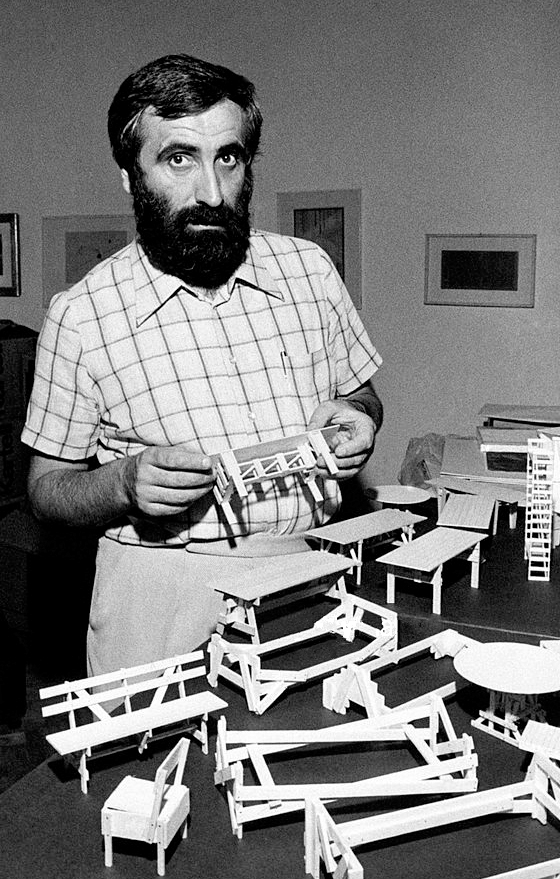
In 1974, Italian designer Enzo Mari published a guide showing how to build furniture using only basic wood and nails. His point was that good design does not require expensive materials or special skills. What matters is understanding how things are put together—how weight is carried, how joints hold. Good design comes from the right relationship between material, assembly, and purpose. The house shares this philosophy.