This easy-to-understand summary is suited for students and language learners. The content has been condensed and scientific references have been omitted. The full context can be found in the complete version in standard language →
The House of Sciences is a place where people learn by doing real projects. There are two main programs.
Build and Test: We use our building and land as a real laboratory. Instead of just making plans on paper, we actually build things and test new ideas at full size. We are looking for partners to help with our building projects.
Live-In Researchers: Students can live at the house and work on their own research projects around the clock. The program moves fast and covers many subjects. There are three focus areas:
Better Living Spaces: We study how room design affects how people feel and work. We also look at how to use smart home technology without losing privacy, and how things like lighting and textures can help people focus.
New Ways to Work: We explore business models for people who want to work for themselves or in small teams. We also research how mixing different skills (for example, coding plus psychology plus carpentry) helps people stay valuable. And we help build businesses that solve real problems while still making money.
Smart and Sustainable Building: We find clever ways to reuse old building materials instead of throwing them away. We also develop simple AI tools for local education and study how businesses can be both profitable and responsible to people and the planet.
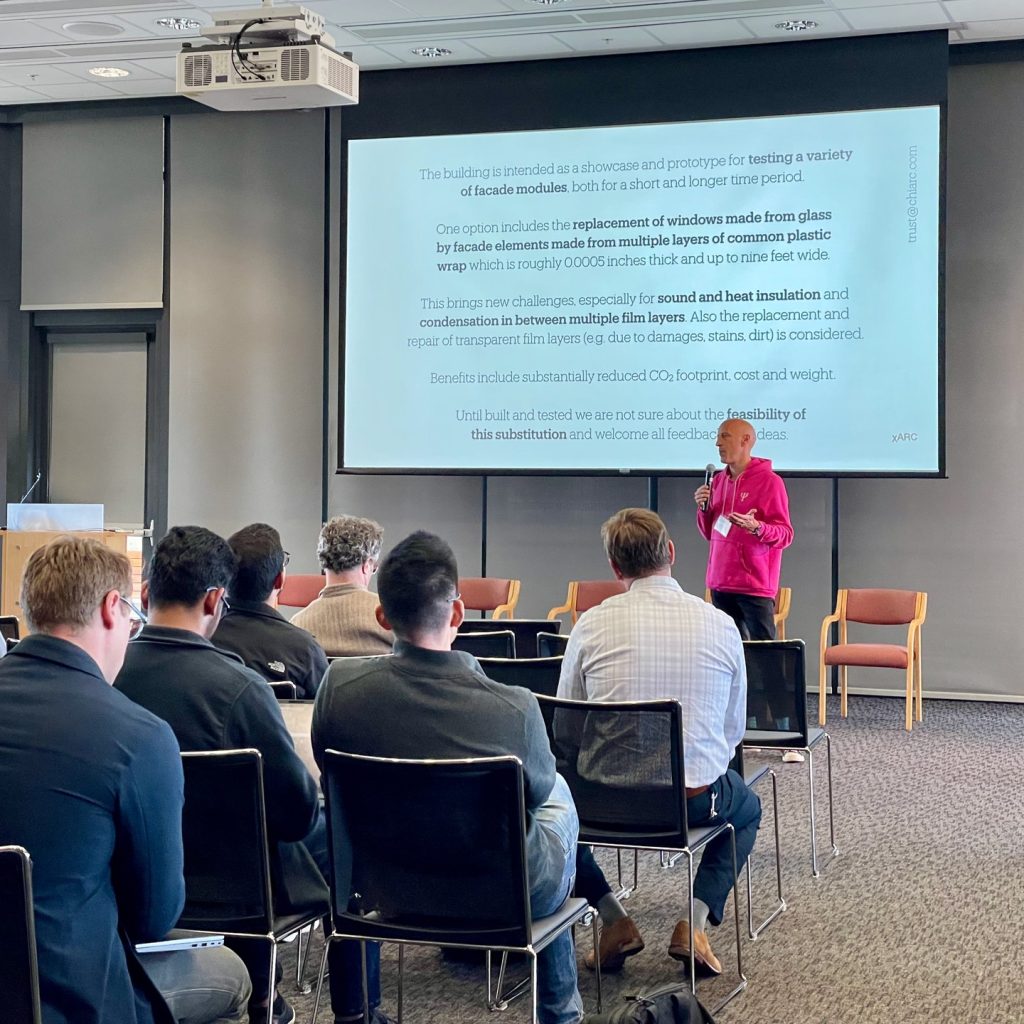
Ansgar Halbfas is asking PhD students for advice on a new building prototype that tests a different window design. His main idea is to replace heavy glass windows with multiple layers of thin plastic wrap to save money and reduce embodied carbon. While this would make buildings much lighter and cheaper, it creates new problems for blocking out noise. Moisture is getting trapped in-between the layers. He wants to know if this “plastic window” idea is actually practical and is looking for creative solutions to help make it work.