This easy-to-understand summary is suited for students and language learners. The content has been condensed and scientific references have been omitted. The full context can be found in the complete version in standard language →
This index lists available documents, sorted by date into these groups: drawings, sketches, documentation, literature and forms.
The Origins of 4-dimensional Planning
In the 1990s, Ansgar Halbfas and some classmates traveled from their main campus in Stuttgart to a research campus in Vaihingen. There they found what they were looking for: early computer models that showed buildings in 3D and over time. These models could show both the current state and the planned future state of a building, making it easier to spot problems early and organize the work better. A digital copy of the building updates in real time as the real building changes.
Circular Economy and Material Health
The cradle-to-cradle method treats a building like a bank for materials. Every part of the building—from the wooden structure to the surface finishes—is chosen so it can be cleanly reused later. When the building is eventually taken apart, all parts can be separated and used to build something new. There is no waste. “The process of taking apart has to be planned during the initial build, to avoid waste and frustration later. We keep an updated database of all building materials and changes, which future owners can access.”
These seven principles are sorted from fixed (no reuse, no recycling) to flexible (all elements can be reused or recycled):
| Principle | Type of connection | Description |
| I (fixed) | Direct chemical connection | Two elements are permanently fixed (no reuse, no recycling). |
| II | Direct connections between two pre-made components | Two elements are dependent in assembly/disassembly (no component reuse). |
| III | Indirect connection with third chemical material | Two elements are connected permanently with third material (no reuse, no recycling). |
| IV | Direct connections with additional fixing devices | Two elements are connected with accessory which can be replaced. If one element has to be removed the whole connection needs to be dismantled. |
| V | Indirect connection via dependent third component | Two elements/components are separated with third element/component, but they have dependence in assembly (reuse is restricted). |
| VI | Indirect connection via independent third component | There is dependence in assembly/ disassembly but all elements could be reused or recycled. |
| VII (flexible) | Indirect with additional fixing device | With change of one element another stays untouched. All elements could be reused or recycled. |
Our commitment to designing for disassembly is made up of many small decisions—including the use of the Open Structures (OS) grid. This shared measurement system makes sure that parts fit together and can be easily swapped or repurposed by future users. This turns the building from a “fixed product” into an “evolving system.”
Unlike standard lumber from a store, working with natural round timber means using computer modeling to deal with the fact that no two logs are exactly the same shape.
Ansgar Halbfas looks at local waste streams before materials get thrown away, and adjusts the design to use whatever is available nearby. When companies or institutions blocked materials from being redirected to the building site—leading to unnecessary disposal—Halbfas found that “material recovery works better when you talk directly to the workers handling the materials, rather than going through management.” Based on this, all future projects will strictly follow circular economy principles, using resources in a regenerative way to minimize environmental impact.
Evidence-Based Design and Prototyping
To reduce risk, the project uses real-world testing before committing to a design. “The House of Sciences welcomes startups and research groups to test their prototype modules and materials at our site, which is centrally located in Germany. We are open to replacing any existing element with your research module or material and comparing its performance on-site. To get the most scientific value, we share relevant performance data from before, during, and after the test phase.” This hands-on testing makes it possible to check how new details perform in real conditions before using them across the whole building.
The project also uses the construction site as a learning environment. People from different backgrounds and fields work and learn together, making sure specialized knowledge is passed on and can grow over time.
The design puts people’s wellbeing at the center, using natural elements—like plants, light, and natural materials—to support the mental health of the people who live and work there.
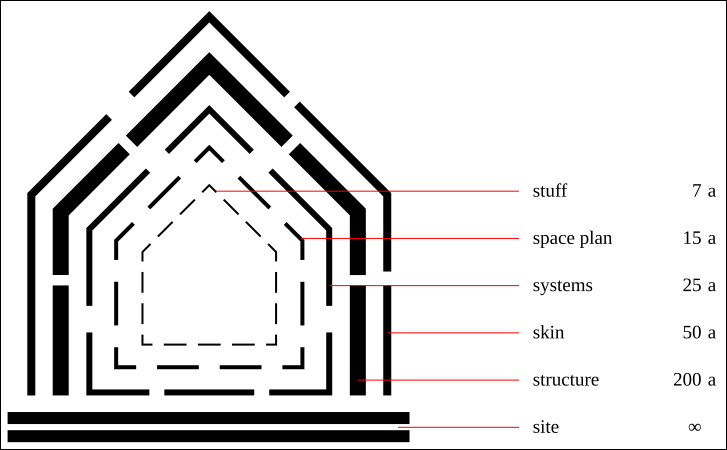
Building on earlier work by Duffy (1992), Brand (1994) developed a model that describes a building as six separate layers, each changing at a different speed. This idea draws on ecology and systems theory, which show that systems operating at different speeds stay largely independent from each other. Brand applied this to buildings: the ability to adapt depends on how independently each layer can change. This means short-lived systems—like pipes and wires—can be updated without touching long-lived systems—like the structure. This principle is called Pace-Layering, and it calls for buildings that are as modular and long-lasting as possible:
Pace layers ↙︎
- Site: The physical location, the neighborhood, and the legal boundaries of the land. This outlasts many generations of buildings.
- Structure: The foundations and load-bearing parts. Costly and risky to change, so people don’t. Lasts 30 to 300 years.
- Skin: The outer surfaces of the building. These change roughly every 20 years—for style, technology upgrades, or repairs. More recently, skins are redesigned to save energy.
- Services: The working systems inside the building: wiring, plumbing, heating, ventilation, and moving parts like elevators. These wear out or become outdated every 7 to 15 years. Many buildings are torn down early simply because their systems are too difficult to replace.
- Space Plan: The interior layout—where walls, ceilings, floors, and doors are. In busy commercial spaces this can change every three years; in quiet homes it might stay the same for thirty years.
- Stuff: Chairs, desks, phones, kitchen appliances, lamps—everything that moves around daily or monthly.
Planning documents for the House of Sciences include a 4D model with current and planned content, as well as drawings on various topics, floor plans, and sections. Depending on the level of detail and the way something was produced, different types of data and documentation apply.
Drawings ↙︎
Sketches ↙︎
Documentation ↙︎
Literature ↙︎
- Using BIM to install structural round timber, PDF · German
- A short art history of German half-timbered buildings, PDF · German
- Work based learning in California, PDF
- Mood for Wood in Poland, the Czech Republic, Slovakia and Hungary
- Open structures grid/manual, PDF · 4.3
- Cradle-to-cradle standards, guidance und methodologies, PDF · 2024
- Building rules lists A, B, and C, PDF · German · 2015
- Technical Building Regulations, PDF · German · 2025
“Building on a budget shouldn’t mean building poorly. Our radical economy approach swaps off-the-shelf products for smart, circular designs and repurposed materials.”
— Ansgar Halbfas, 2023
A tight budget pushes you to be creative: get the most out of the least.
Knowledge Transfer: Strategy for Success
This isn’t just a project archive—it’s an open book. From German building laws to small-scale living, our hard-won insights are now available to you. If you want to build sustainably without spending too much, skip the trial-and-error phase. Use our strategies to move faster and save your budget for what really matters ↗︎
Spatial Organization and Functional Distribution
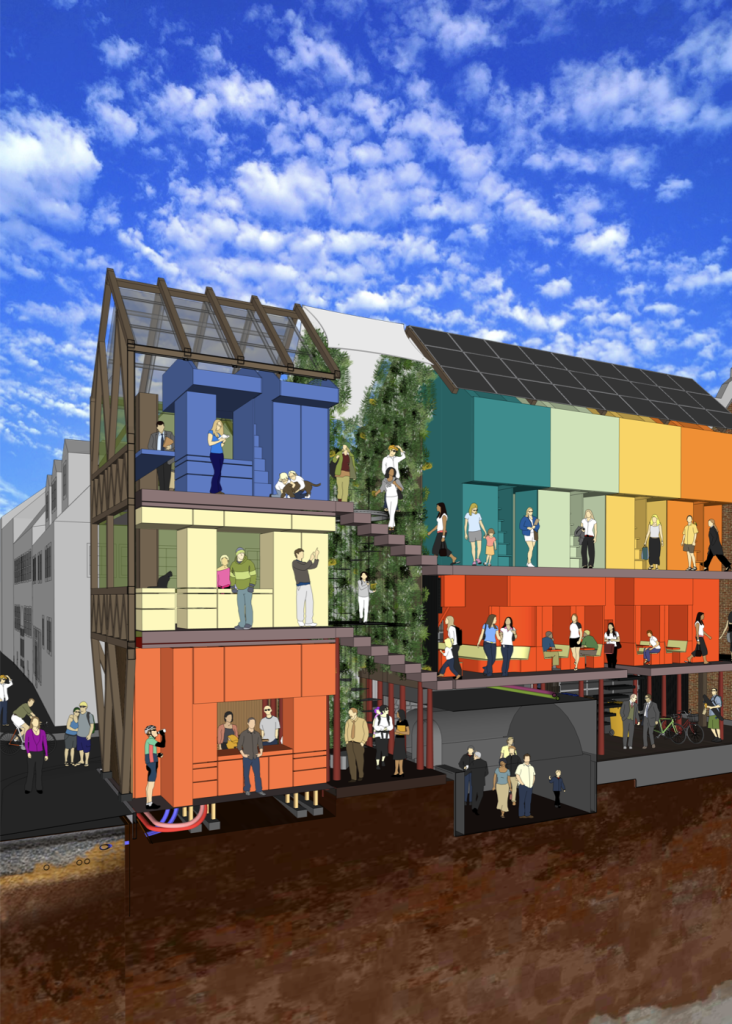
Level A (Vaulted cellar & Street): A flexible underground space for digital presentations and hosting guests. At street level: a small service pod for social interaction, and a workshop for bicycle repairs and technical projects.
Communal Zones (B): These floors bring shared spaces together—including a kitchen and dining area built for serious cooking and international food exchange.
Residential Units (C): The upper floors hold private rooms, designed for quiet study and rest.
Building Core: A vertical garden running through the building, offering space for plants and quiet reflection.
Operational Strategy
High-use shared spaces—like workshops and technical areas—are placed on the lower floors. Private rooms are on the upper floors. This keeps community life and personal study separate, while still close together.